Chingu
How to Say Sorry in Korean: Every Way to Apologize Properly (2026)
Learn every way to say sorry in Korean, from formal 죄송합니다 (joesonghamnida) to casual 미안해 (mianhae). Includes formality levels, cultural context, responding to apologies, and common mistakes foreigners make.
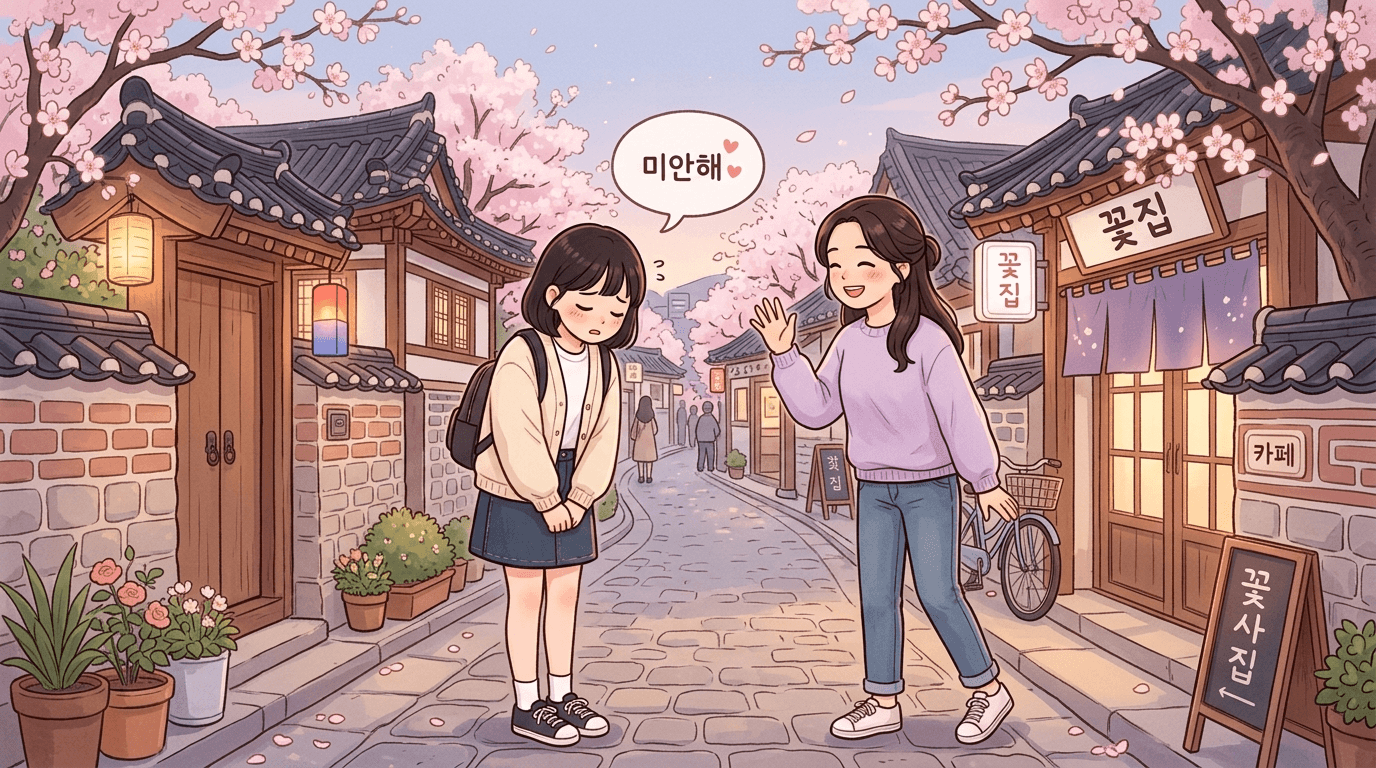
Knowing how to say sorry in Korean is one of the most essential skills you can develop as a learner of the language. Apologies carry enormous weight in Korean culture — far more than in most Western societies. Getting an apology wrong can damage a relationship, while getting it right can repair one almost instantly. Whether you accidentally bump someone on the subway in Seoul, show up late to a meeting, or need to express deep regret for a serious mistake, the Korean apology you choose signals your awareness of the situation, your respect for the other person, and your understanding of social hierarchy.
In this comprehensive guide, you’ll learn every major way to say sorry in Korean, understand the formality levels behind each expression, discover the cultural context that makes Korean apologies unique, and pick up practical tips for both giving and receiving apologies. If you’re just starting your Korean journey, our beginner’s guide to learning Korean will give you a complete roadmap for the basics.
Why Apologies Matter So Much in Korean Culture
In English, “sorry” is a versatile word. We toss it around casually — “sorry, could you repeat that?” or “sorry, my bad” — without much thought. In Korean culture, apologies are taken far more seriously. They are deeply connected to concepts of social harmony (화합, hwahap), face-saving (체면, chemyeon), and respect for hierarchy.
Korea is a collectivist society where maintaining group harmony is paramount. When someone makes a mistake, the apology isn’t just about acknowledging what went wrong — it’s about restoring the social equilibrium. A proper apology shows that you value the relationship and the other person’s feelings above your own ego. This is why Korean has so many different ways to say sorry, each calibrated to a specific level of formality and sincerity.
Korean apologies also involve more than just words. Body language plays a critical role: the depth and duration of your bow, your eye contact (or lack thereof), and even the tone of your voice all communicate the depth of your regret. A casual “sorry” tossed over your shoulder would be considered shockingly rude in situations that call for a formal apology. Just as Korean has multiple ways to say hello and say thank you, the variety in apology expressions reflects the language’s deep emphasis on social context.
The Two Core “Sorry” Words in Korean
Before diving into specific expressions, it’s important to understand that Korean has two main roots for apologies, similar to how it has two roots for “thank you” (감사 and 고맙다).
죄송 (Joesong) — Sino-Korean Root
죄송 comes from the Chinese characters 罪悚, where 죄 means “sin” or “crime” and 송 means “fear” or “trembling.” Literally, it conveys the idea of being so sorry that you tremble with guilt. Expressions built on 죄송 sound formal, professional, and deeply respectful. You’ll use 죄송-based apologies in business settings, with elders, with strangers, and in any situation that demands a high level of deference.
미안 (Mian) — Sino-Korean Root (But More Casual in Usage)
미안 also has Sino-Korean origins (from 未安, meaning “not at peace” or “uneasy”), but in modern Korean it functions as the warmer, more personal, and less formal apology word. Expressions built on 미안 feel more heartfelt and emotionally direct. You’ll use 미안-based apologies with friends, family, romantic partners, and people you’re close to — though the polite forms of 미안 are also perfectly appropriate in many everyday situations.
Every Way to Say Sorry in Korean (By Formality Level)
Below is a complete breakdown of Korean apology expressions, organized from most formal to most casual. Understanding these levels is essential for apologizing correctly in Korean.
1. 죄송합니다 (Joesonghamnida) — Most Formal
Formality: Very high (formal polite / 합쇼체)
When to use: Business meetings, talking to elders, customer service situations, public apologies, formal events, interactions with strangers who are older than you, speaking to authority figures.
죄송합니다 (joesonghamnida) is the most respectful way to say sorry in Korean. If you only learn one apology expression, make it this one. It is safe in virtually every situation where an apology is needed, from accidentally stepping on someone’s foot in the subway to making a serious mistake at work. The -ㅂ니다 (-mnida) ending signals the highest everyday level of polite speech.
Example sentences:
- 늦어서 죄송합니다. (Neujeoseo joesonghamnida.) — I’m sorry for being late.
- 불편을 드려 죄송합니다. (Bulpyeoneul deuryeo joesonghamnida.) — I’m sorry for the inconvenience.
- 실수해서 정말 죄송합니다. (Silsuhaeseo jeongmal joesonghamnida.) — I’m truly sorry for the mistake.
Pronunciation tip: The ㅂ in 합 nasalizes before ㄴ, so the natural pronunciation is closer to “joe-song-ham-ni-da” (not “joe-song-hab-ni-da”). This is the same nasalization rule that applies to 감사합니다.
2. 죄송해요 (Joesonghaeyo) — Polite
Formality: Medium-high (standard polite / 해요체)
When to use: Everyday polite situations, acquaintances, people your age or slightly older in semi-formal settings, service interactions where 합니다 feels too stiff.
죄송해요 is the standard polite form of the 죄송 apology. It carries the respectful weight of 죄송 but feels slightly less formal than 죄송합니다. In practice, many Koreans prefer jumping straight to 죄송합니다 rather than using this middle form, but 죄송해요 is perfectly natural and commonly used, especially in spoken Korean where the full formal ending can feel overly rigid in casual-polite contexts.
Example sentences:
- 방해해서 죄송해요. (Banghaehaeseo joesonghaeyo.) — Sorry for disturbing you.
- 제가 잘못했어요, 죄송해요. (Jega jalmothaesseoyo, joesonghaeyo.) — It was my fault, I’m sorry.
3. 미안합니다 (Mianhamnida) — Formal but Personal
Formality: High (formal polite / 합쇼체)
When to use: Formal situations where you want to sound sincere and personally sorry rather than just professionally apologetic. Also common in public apologies that aim for emotional weight.
미안합니다 combines the personal warmth of 미안 with the formal -ㅂ니다 ending. While 죄송합니다 is the go-to formal apology in most professional and hierarchical situations, 미안합니다 is sometimes chosen when the speaker wants to convey a deeper personal emotional connection to the apology. You might hear it when a public figure apologizes with visible emotion or when someone feels genuine personal guilt.
Example sentences:
- 정말 미안합니다. (Jeongmal mianhamnida.) — I’m truly sorry.
- 그때 그렇게 말해서 미안합니다. (Geuttae geureoke malhaeseo mianhamnida.) — I’m sorry for what I said back then.
4. 미안해요 (Mianhaeyo) — Casual-Polite
Formality: Medium (standard polite / 해요체)
When to use: Everyday polite situations with people your age, friendly acquaintances, coworkers you have a comfortable relationship with, someone you’ve just met in a casual setting.
미안해요 is the most versatile middle-ground Korean apology. It’s polite enough to use with people you don’t know well, but warm enough that it doesn’t feel stiff or distant. For daily life in Korea — bumping someone in a hallway, being a few minutes late to meet a friend, or forgetting to reply to a message — 미안해요 is often the most natural choice.
Example sentences:
- 답장 늦어서 미안해요. (Dapjang neujeoseo mianhaeyo.) — Sorry for the late reply.
- 깜빡했어요, 미안해요. (Kkamppakhaesseoyo, mianhaeyo.) — I forgot, sorry.
- 오래 기다렸죠? 미안해요. (Orae gidaryyeotjyo? Mianhaeyo.) — You waited a long time, right? Sorry.
5. 미안해 (Mianhae) — Casual / Intimate
Formality: Low (casual / 반말)
When to use: Close friends, younger siblings, romantic partners, children, people who have agreed to speak in 반말 with you.
미안해 is the casual form of sorry that you’ll hear constantly in K-dramas, K-pop lyrics, and between close friends. It’s warm, direct, and emotionally sincere — but using it with someone you should be polite to (elders, strangers, superiors) is considered rude. Only use 미안해 when you’re sure the relationship calls for casual speech.
Example sentences:
- 미안해, 내가 잘못했어. (Mianhae, naega jalmothaesseo.) — Sorry, it was my fault.
- 진짜 미안해. (Jinjja mianhae.) — I’m really sorry.
- 늦어서 미안해! (Neujeoseo mianhae!) — Sorry I’m late!
In K-dramas, you’ll often hear characters deliver an emotional 미안해 during heart-wrenching scenes — breakups, farewells, and long-overdue confessions of guilt. It’s one of the most emotionally loaded words in casual Korean.
6. 미안 (Mian) — Very Casual
Formality: Very low (abbreviated casual)
When to use: Very close friends, texting, quick informal apologies for minor things.
미안 is the stripped-down, ultra-casual version of 미안해. It’s the Korean equivalent of a quick “my bad” in English. You’d use it when you bump a friend lightly, take the last piece of chicken, or show up two minutes late to a casual hangout. It carries zero formality and should never be used outside of very close, equal-status relationships.
Example usage:
- 아, 미안미안. (A, mianmian.) — Oh, sorry sorry. (Doubling it for a casual, playful apology)
- 미안, 까먹었어. (Mian, kkameogeosseo.) — Sorry, I forgot.
Quick Reference Table: Korean Sorry Expressions
| Expression | Romanization | Formality | Best Used With |
|---|---|---|---|
| 죄송합니다 | Joesonghamnida | Very formal | Elders, strangers, business, authority figures |
| 죄송해요 | Joesonghaeyo | Polite | Acquaintances, semi-formal daily situations |
| 미안합니다 | Mianhamnida | Formal (personal) | Formal but emotionally sincere apologies |
| 미안해요 | Mianhaeyo | Casual-polite | Peers, friendly acquaintances, daily life |
| 미안해 | Mianhae | Casual | Close friends, romantic partners, younger people |
| 미안 | Mian | Very casual | Very close friends, texting, minor things |
Sorry vs. Excuse Me: 실례합니다 and 잠시만요
One source of confusion for Korean learners is the difference between apologizing for something you’ve done and politely getting someone’s attention or asking them to move. In English, “excuse me” and “sorry” often overlap. In Korean, they are distinct.
실례합니다 (Sillyehamnida) — “Excuse Me” (Formal)
- Hangul: 실례합니다
- Romanization: Sillyehamnida
- Meaning: Excuse me / Pardon me (formal)
- When to use: Approaching a stranger to ask a question, interrupting a conversation, entering a room, getting someone’s attention politely
실례합니다 literally means “I am being rude” (실례 means “rudeness”). You’re acknowledging that you’re about to impose on someone. It’s not an apology for wrongdoing — it’s a preemptive courtesy.
Example usage:
- 실례합니다, 화장실이 어디에 있어요? (Sillyehamnida, hwajangsiri eodie isseoyo?) — Excuse me, where is the restroom?
- 실례지만, 지금 몇 시예요? (Sillyejiman, jigeum myeot siyeyo?) — Excuse me, but what time is it?
잠시만요 (Jamsimanyo) — “Just a Moment” / “Excuse Me”
- Hangul: 잠시만요
- Romanization: Jamsimanyo
- Meaning: Just a moment / Excuse me (to pass by)
- When to use: Squeezing past someone in a crowded area, asking someone to wait briefly, needing to get through a crowd
잠시만요 literally means “just a moment, please.” It’s the phrase you’ll use most often in busy Korean spaces — on the subway, in crowded markets, or when you need to slip past someone in a narrow aisle. The casual version is 잠시만 (jamsiman) or 잠깐만요 (jamkkanmanyo).
When to Use Which
| Situation | Expression | Why |
|---|---|---|
| Asking a stranger for directions | 실례합니다 | Politely getting their attention |
| Squeezing past someone on the subway | 잠시만요 | Asking them to make room briefly |
| You accidentally step on someone’s foot | 죄송합니다 | Apologizing for something you did |
| Interrupting a meeting | 실례합니다 | Acknowledging the interruption before speaking |
| You spill coffee on someone | 죄송합니다 / 미안해요 | Genuine apology for a mistake |
How to Intensify Your Korean Apology
Sometimes a standard “sorry” isn’t enough. Here’s how to make your apology stronger in Korean:
- 정말 죄송합니다 (Jeongmal joesonghamnida) — I’m truly sorry (formal)
- 너무 죄송합니다 (Neomu joesonghamnida) — I’m so sorry (formal)
- 진심으로 사과드립니다 (Jinsimeuro sagwadeurimnida) — I sincerely apologize (very formal, used in public statements)
- 정말 미안해요 (Jeongmal mianhaeyo) — I’m truly sorry (polite)
- 너무너무 미안해 (Neomu neomu mianhae) — I’m sooo sorry (casual, often used by younger speakers)
- 진짜 미안해 (Jinjja mianhae) — I’m really sorry (casual, emphatic)
The words 정말 (jeongmal, “truly”) and 진짜 (jinjja, “really/for real”) are the most useful intensifiers. 정말 sounds slightly more mature and sincere, while 진짜 is more casual and emphatic. Adding either before your apology signals that you genuinely mean it.
How to Respond to Apologies in Korean
Knowing how to apologize is only half the equation. You also need to know how to accept (or deflect) an apology gracefully. Koreans tend to downplay the offense to restore social harmony.
괜찮아요 (Gwaenchanayo) — “It’s Okay”
This is the most common response to an apology in Korean. 괜찮아요 means “it’s okay” or “it’s fine” and is the standard way to accept an apology and signal that no harm was done. The casual version is 괜찮아 (gwaenchana).
아니에요 (Anieyo) — “It’s Nothing” / “Not at All”
Just like with thank-you responses, 아니에요 is used to minimize the situation. It implies “you don’t need to apologize” or “it’s really not a big deal.”
신경 쓰지 마세요 (Singyeong Sseuji Maseyo) — “Don’t Worry About It”
A polite way to tell someone not to worry. 신경 쓰지 마세요 literally means “don’t use your nerves (on this).” The casual version is 신경 쓰지 마 (singyeong sseuji ma).
별거 아니에요 (Byeolgeo Anieyo) — “It’s No Big Deal”
This expression means “it’s nothing special” or “it’s not a big deal.” Use it when you genuinely want to dismiss the offense entirely.
Response Table
| Response | Romanization | Meaning | Formality |
|---|---|---|---|
| 괜찮습니다 | Gwaenchansseumnida | It’s fine | Formal |
| 괜찮아요 | Gwaenchanayo | It’s okay | Polite |
| 괜찮아 | Gwaenchana | It’s fine / No worries | Casual |
| 아니에요 | Anieyo | Not at all / It’s nothing | Polite |
| 신경 쓰지 마세요 | Singyeong sseuji maseyo | Don’t worry about it | Polite |
| 별거 아니에요 | Byeolgeo anieyo | It’s no big deal | Polite |
Cultural Context: Korean Apology Culture Runs Deep
Korean apology culture is complex and deeply ingrained in social life. Understanding these cultural dimensions will help you navigate real-world situations far better than memorizing phrases alone.
The Public Apology (사과, Sagwa)
In Korean public life, formal apologies are major events. When a CEO, politician, or celebrity makes a mistake, the public often expects a formal press conference apology. These apologies follow a specific format: the person stands (or sometimes kneels), delivers a prepared statement using highly formal language (often including 진심으로 사과드립니다), and performs a deep 90-degree bow that is held for several seconds. The bow itself is critical — its depth and duration are scrutinized as indicators of sincerity.
In 2014, after the Sewol Ferry disaster, national grief was accompanied by a wave of public apologies that were analyzed frame-by-frame by the media. Apologies that were deemed insufficiently deep or too brief were harshly criticized. This illustrates just how seriously Korean society takes the physical and verbal components of a formal apology.
Apology as Relationship Repair
In Korean relationships — whether romantic, familial, or between friends — apologies function as relationship repair tools. Korean culture views conflict as a disruption to 정 (jeong, the deep emotional bond between people), and a sincere apology is the primary way to restore that bond. This is why Koreans often apologize more quickly and more thoroughly than Westerners might expect. The goal isn’t to assign blame — it’s to restore harmony.
The Body Language of Korean Apologies
Just as with Korean greetings, body language is an inseparable part of the apology. Here’s what’s expected:
- Slight nod (15°): A quick acknowledgment for very minor things — bumping someone lightly, a small conversational mistake.
- Standard bow (30°): The most common apology bow. Used when you’re genuinely sorry for an everyday mistake — being late, forgetting something, minor inconveniences.
- Deep bow (45–90°): Reserved for serious apologies — professional mistakes, offending someone significantly, formal public apologies. The deeper and longer the bow, the more sincere the apology appears.
- Kneeling bow (큰절, keunjeol): The most extreme form of apology. Kneeling and bowing to the floor is reserved for grave offenses or deeply emotional situations. In public life, it’s sometimes used by politicians or business leaders to express remorse for serious scandals.
As a foreigner, you won’t be expected to kneel, but combining a genuine 30-degree bow with 죄송합니다 will make your apology feel sincere and culturally appropriate.
Apologizing Even When It’s Not Your Fault
One cultural aspect that surprises many foreigners is that Koreans sometimes apologize even when they haven’t done anything wrong. If a friend tells you about their bad day, you might hear a Korean speaker say 미안해 — not because they caused the problem, but as an expression of empathy and shared emotional burden. This is similar to how English speakers say “I’m sorry to hear that,” but in Korean it can feel more personally invested.
When NOT to Apologize in Korean
While Korean culture values apologies, there are situations where apologizing can actually backfire or seem strange:
- Over-apologizing for trivial things: If you apologize profusely every time you ask a question or make a tiny error, Koreans may find it exhausting or feel like you’re putting them in an awkward position. A quick 아, 미안해요 is enough for minor things — save the deep apologies for when they matter.
- Apologizing without changing behavior: In Korean culture, an apology without follow-through is worse than no apology at all. If you keep making the same mistake and keep saying 죄송합니다, the apology loses all meaning. Koreans notice actions more than words.
- Apologizing when you should be thanking: This is a common mistake for English speakers. In English, we often say “sorry for the trouble” when someone helps us. In Korean, the more appropriate response in many of these situations is 감사합니다 (thank you) rather than 죄송합니다. If someone goes out of their way to help you, lead with gratitude, not apology.
- Excessive self-deprecation: While humility is valued in Korean culture, constantly apologizing for your existence (“sorry for my Korean,” “sorry for taking your time”) can come across as lacking confidence. A single, natural apology is appreciated. Repeated, unnecessary ones can make the other person uncomfortable.
Common Mistakes Foreigners Make with Korean Apologies
Avoid these pitfalls and your Korean apologies will land much better:
- Using 미안해 with strangers or elders: This is the number one mistake. 미안해 is casual speech, and using it with someone you should be polite to is disrespectful. When in doubt, use 죄송합니다.
- Confusing 죄송합니다 with 실례합니다: 죄송합니다 is for apologizing after you’ve done something wrong. 실례합니다 is for “excuse me” before you impose on someone. Saying 죄송합니다 when you just need to ask for directions sounds overly dramatic.
- Not bowing: Words without the appropriate body language feel hollow. Even a slight nod adds sincerity. Standing completely still while saying 죄송합니다 can seem insincere.
- Using the wrong intensifier: Saying 너무너무 죄송합니다 (with the casual-sounding doubled intensifier) in a business context sounds mismatched. Use 대단히 죄송합니다 (daedanhi joesonghamnida) or 깊이 사과드립니다 (gipi sagwadeurimnida) for formal settings.
- Apologizing only with words: In Korean culture, actions after an apology are critical. If you make a mistake at work and say 죄송합니다, you’re also expected to show how you’ll fix it or prevent it from happening again. An apology without a plan of action can feel empty.
- Mixing formality levels: Starting with 죄송합니다 and then switching to 미안해 in the same conversation with the same person is jarring. Pick one formality level and stick with it throughout the interaction.
Famous K-Drama Apology Scenes
K-dramas offer some of the best real-world examples of Korean apologies in action. Watching these scenes will help you understand the emotional weight and social dynamics behind Korean apologies better than any textbook can.
The Rain-Soaked 미안해
One of the most iconic K-drama tropes is the rain apology — a character chases someone through the rain, grabs their wrist, and delivers a tearful “미안해... 정말 미안해” (I’m sorry... I’m truly sorry). This scene archetype appears across dozens of dramas and illustrates how 미안해 can carry immense emotional weight in intimate contexts. The rain serves as a metaphor: the character is willing to endure discomfort to express their regret.
The Formal Corporate Apology
Business-themed K-dramas (like Misaeng or Start-Up) frequently show workplace apology scenes. Watch for the 90-degree bow combined with “죄송합니다” when an employee makes a mistake before a superior. Notice how the superior’s response — whether they say 괜찮아요 or remain silent — signals the severity of the situation and the power dynamic at play.
The Parent Apology
Some of the most emotionally powerful scenes in K-dramas involve parents apologizing to their children (or vice versa) with a tearful “미안하다” (mianhada, the plain/dictionary form, used as a raw emotional statement). These scenes highlight how apologies in Korean family life are deeply connected to 정 and often involve years of unspoken regret. The plain form 미안하다 is used here not as rude casual speech, but as a raw, unfiltered emotional expression — almost like thinking aloud.
The Pride-Swallowing Confession
In many K-drama romances, the male lead — typically proud and stoic — eventually reaches a breaking point where he admits fault with a quiet “미안해. 내가 잘못했어.” (Sorry. It was my fault.) This moment is powerful precisely because Korean culture ties apologies to humility, and for a proud character to openly acknowledge their wrongdoing represents real emotional growth.
Apology Expressions for Specific Situations
Here are the most natural apology phrases for common real-life situations in Korea:
Being Late
- Formal: 늦어서 죄송합니다. (Neujeoseo joesonghamnida.) — I’m sorry for being late.
- Polite: 늦어서 미안해요. (Neujeoseo mianhaeyo.) — Sorry I’m late.
- Casual: 늦어서 미안! (Neujeoseo mian!) — Sorry I’m late!
Bumping into Someone
- Formal: 아, 죄송합니다! (A, joesonghamnida!) — Oh, I’m sorry!
- Polite: 아, 미안해요! (A, mianhaeyo!) — Oh, sorry!
Making a Mistake at Work
- 죄송합니다, 다시 확인하겠습니다. (Joesonghamnida, dasi hwaginhagetseumnida.) — I’m sorry, I’ll double-check it.
- 실수해서 죄송합니다. 바로 수정하겠습니다. (Silsuhaeseo joesonghamnida. Baro sujeonghagetseumnida.) — I’m sorry for the mistake. I’ll correct it right away.
Canceling Plans
- Polite: 갑자기 일이 생겨서 미안해요. (Gapjagi iri saenggyeoseo mianhaeyo.) — Sorry, something came up suddenly.
- Casual: 미안, 오늘 못 갈 것 같아. (Mian, oneul mot gal geot gata.) — Sorry, I don’t think I can make it today.
Forgetting Something
- Polite: 깜빡하고 못 가져왔어요, 죄송해요. (Kkamppakhago mot gajyeowasseoyo, joesonghaeyo.) — I forgot to bring it, sorry.
- Casual: 아, 까먹었어. 미안! (A, kkameogeosseo. Mian!) — Ah, I forgot. Sorry!
Korean Apology Texting and Online
Korean texting culture has its own abbreviated and expressive ways to apologize:
- ㅈㅅ (js) — Abbreviation of 죄송 (joesong), using the first consonants. Used in online chats and gaming. Very informal.
- ㅁㅇ (my) — Abbreviation of 미안 (mian). Extremely casual texting shorthand.
- 미안미안 (mianmian) — Doubling the word for a playful, light “sorry sorry!”
- 미안해요~ (mianhaeyo~) — Adding a tilde for a softer, friendlier tone.
- 쏘리 (ssori) — Konglish version of “sorry,” used playfully between friends.
These are strictly for casual texting with close friends or in online spaces. Using ㅈㅅ in a work email would be like texting “sry lol” to your boss.
How to Practice Korean Apologies
Memorizing apology phrases from a list is a good start, but the real skill is using them naturally in the right context with the right formality level. Here are practical ways to build that instinct:
1. Watch K-Dramas with an Apology Focus
Pick any K-drama episode and pay attention to every apology scene. Notice who says what to whom, the formality level they choose, the accompanying body language, and how the other person responds. You’ll quickly develop an intuition for which expressions fit which situations.
2. Practice with AI Conversation Partners
AI conversation partners let you practice apology scenarios in a zero-pressure environment. You can simulate being late to meet a Korean friend, making a mistake at a Korean workplace, or accidentally bumping into a stranger — and get real-time feedback on whether you used the right formality level. Apps like Chingu let you chat with Korean-speaking AI friends who respond naturally and correct your mistakes, making it an ideal way to internalize these expressions before using them in real life.
3. Role-Play Specific Scenarios
Practice matching the right apology to the right situation:
- You arrive 20 minutes late to a business meeting — what do you say?
- You accidentally bump a stranger on the subway — what do you say?
- You forgot your friend’s birthday — what do you say?
- You need to cancel dinner plans with a colleague — what do you say?
- You spill a drink on your partner’s shirt — what do you say?
4. Learn the “V + 아/어서 죄송합니다” Pattern
This grammar pattern means “I’m sorry for [doing something]” and is extremely practical:
- 늦어서 죄송합니다 (neujeoseo joesonghamnida) — Sorry for being late
- 실수해서 죄송합니다 (silsuhaeseo joesonghamnida) — Sorry for the mistake
- 연락 못 해서 죄송합니다 (yeollak mot haeseo joesonghamnida) — Sorry for not being in touch
- 기다리게 해서 죄송합니다 (gidarige haeseo joesonghamnida) — Sorry for making you wait
Mastering this pattern lets you apologize specifically for almost anything. Simply swap in any verb before -아/어서 and add your preferred apology ending.
Frequently Asked Questions
What is the most common way to say sorry in Korean?
The most common and universally safe way to say sorry in Korean is 죄송합니다 (joesonghamnida). It works in virtually every situation — with strangers, elders, colleagues, and in any public setting. If you’re unsure which expression to use, 죄송합니다 is always a safe choice. For casual situations with close friends, 미안해 (mianhae) is the most natural option.
What is the difference between 죄송합니다 and 미안합니다?
Both are formal polite expressions meaning “I’m sorry,” but they carry slightly different nuances. 죄송합니다 is the more professionally respectful option, commonly used in business, with elders, and with authority figures. 미안합니다 is also formal but feels more personally heartfelt and emotionally direct. In most everyday formal situations, 죄송합니다 is the safer default.
Is it rude to say 미안해 to a stranger?
Yes. 미안해 is casual speech (반말) and should only be used with close friends, younger people, or those who have explicitly agreed to speak casually with you. Using it with a stranger, especially an older one, can come across as disrespectful. Use 죄송합니다 or 미안해요 with strangers instead.
How do you respond when someone says sorry to you in Korean?
The most common response is 괜찮아요 (gwaenchanayo), meaning “it’s okay.” You can also say 아니에요 (anieyo, “it’s nothing”) or 신경 쓰지 마세요 (singyeong sseuji maseyo, “don’t worry about it”). For casual situations, 괜찮아 (gwaenchana) works perfectly.
What is the difference between 실례합니다 and 죄송합니다?
실례합니다 (sillyehamnida) means “excuse me” and is used before you impose on someone — like asking a question, interrupting, or getting attention. 죄송합니다 (joesonghamnida) means “I’m sorry” and is used after you’ve done something wrong — like making a mistake, being late, or causing inconvenience. Think of 실례합니다 as preemptive courtesy and 죄송합니다 as reactive apology.