Chingu
How to Say Hello in Korean: The Complete Guide to Korean Greetings (2026)
Learn how to say hello in Korean with every greeting you need. From formal annyeonghaseyo to casual slang, master Korean greetings with Hangul, romanization, and cultural tips.
Knowing how to say hello in Korean is the very first step on your language-learning journey — and one of the most important. Korean culture places enormous value on respect, hierarchy, and social harmony, and the greeting you choose tells the other person exactly how you perceive the relationship. Use the wrong one and you might accidentally offend a stranger; use the right one and you’ll immediately earn respect, even as a beginner.
In this guide you’ll learn every Korean greeting you need: formal, polite, casual, phone-specific, seasonal, time-based, and more. Each entry includes the original Hangul, romanization, literal meaning, and clear guidance on when and with whom to use it. By the end, you’ll be able to greet anyone in Korean — from your best friend to a company CEO — with total confidence. If you’re just starting out, you may also want to read our beginner’s guide to learning Korean for a complete roadmap.
Why Korean Greetings Matter More Than You Think
In English, “hello” works in almost every situation. Korean is different. The language has multiple speech levels, and the greeting you pick signals your age relative to the listener, how well you know them, and how much respect the situation demands. Getting it right is not optional — it’s a core part of Korean social etiquette.
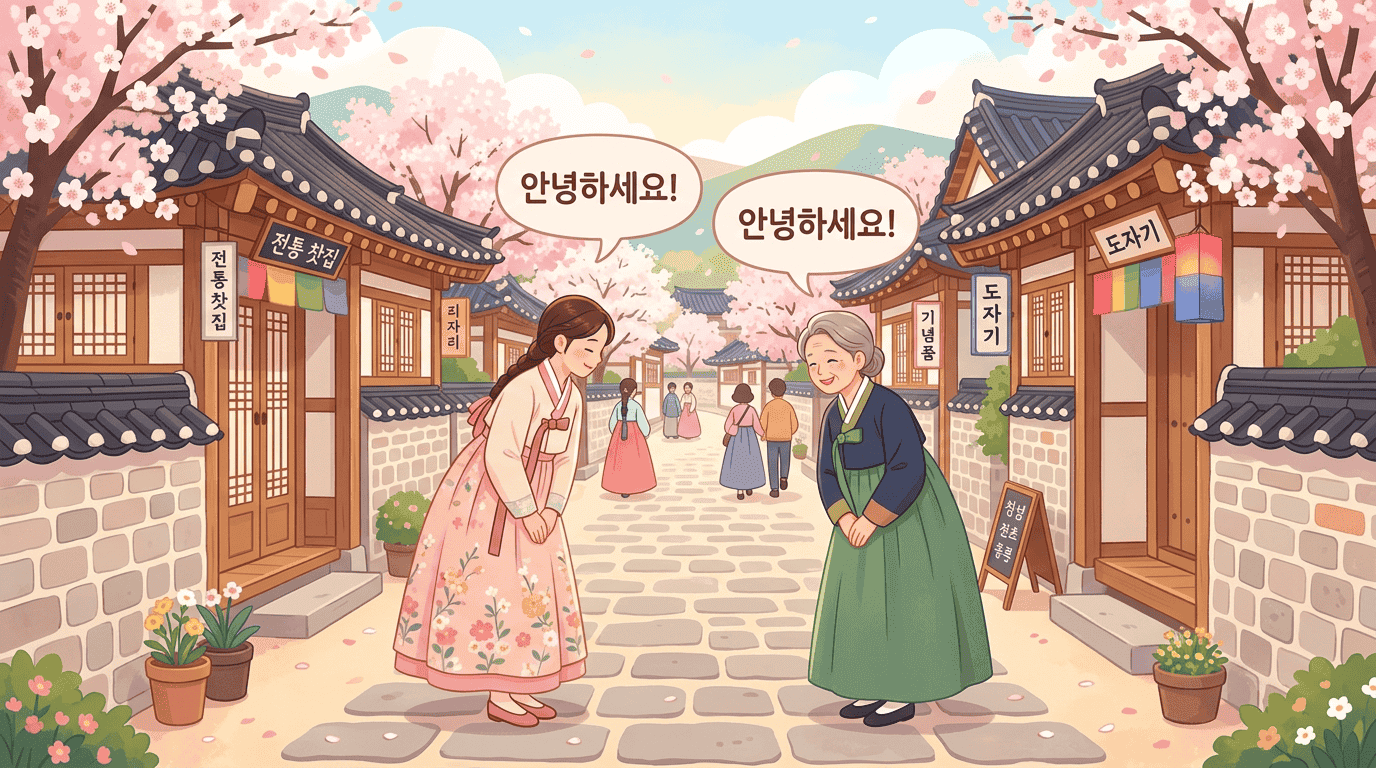
Korean greetings are also often accompanied by a bow. The depth of the bow varies:
- Slight nod (15°): Between friends, casual acquaintances, or colleagues of similar age.
- Standard bow (30°): The most common bow. Used when greeting elders, teachers, bosses, or customers.
- Deep bow (45–90°): Reserved for very formal occasions — meeting a grandparent for the first time, a traditional ceremony, or an apology.
Understanding these layers will help you navigate Korean social situations far more smoothly than vocabulary alone ever could.
The Standard Korean Hello: 안녕하세요 (Annyeonghaseyo)
If you learn only one Korean greeting, make it this one. 안녕하세요 (annyeonghaseyo) is the universal, polite way to say hello in Korean. It works with strangers, colleagues, shopkeepers, teachers, and almost anyone you meet in daily life.
Breaking it down:
- 안녕 (annyeong) — peace, well-being
- 하세요 (haseyo) — a polite verb ending meaning “do you do?”
So 안녕하세요 literally translates to “Are you at peace?” or “Are you doing well?” It can be used at any time of day — morning, afternoon, or evening — making it the Korean equivalent of a universal “hello.”
Pronunciation tip: The “ha” in the middle is soft and quick. Many beginners over-pronounce it. Listen to native speakers and you’ll notice it almost blends into the surrounding syllables: an-nyeong-ha-se-yo.
When to Use 안녕하세요
- Meeting someone for the first time
- Entering a shop, restaurant, or office
- Greeting a colleague at work
- Speaking to anyone older than you (unless they’re very close)
- Any situation where you’re unsure which formality level to use
When in doubt, default to 안녕하세요. It is never rude, and Koreans will appreciate the effort.
Formal Korean Greetings
Korea’s hierarchical culture means formal speech is essential in professional settings, with elders, and in public-facing situations. Here are the key formal greetings.
안녕하십니까 (Annyeonghasimnikka)
This is the most formal way to say hello in Korean. You’ll hear it on news broadcasts, in military settings, during corporate presentations, and at formal ceremonies.
- Hangul: 안녕하십니까
- Romanization: Annyeonghasimnikka
- Meaning: Hello (very formal)
- When to use: Business meetings, speeches, addressing high-ranking officials, formal interviews, military contexts
Unless you work in a Korean corporate environment or are giving a formal speech, you won’t need this greeting often. But knowing it shows a high level of cultural awareness.
처음 뵙겠습니다 (Cheoeum Boepgesseumnida)
This is the formal way to say “Nice to meet you” in Korean. It literally means “I am seeing you for the first time.”
- Hangul: 처음 뵙겠습니다
- Romanization: Cheoeum boepgesseumnida
- Meaning: Nice to meet you (formal)
- When to use: First meeting in business or formal social settings
You would pair this with a 30° bow and usually follow it by stating your name: “저는 [name]입니다. 처음 뵙겠습니다.”
만나서 반갑습니다 (Mannaseo Bangapseumnida)
Another way to say “Nice to meet you,” slightly less stiff than 처음 뵙겠습니다 but still formal and polite.
- Hangul: 만나서 반갑습니다
- Romanization: Mannaseo bangapseumnida
- Meaning: Nice to meet you / Glad to meet you
- When to use: First meetings in both formal and semi-formal contexts
Informal and Casual Korean Greetings
With close friends, younger people, and family members your age or younger, formal speech can actually sound awkward or distant. These are the greetings for your inner circle.
안녕 (Annyeong)
The casual, stripped-down version of 안녕하세요. Think of it as the Korean “hi” or “hey.”
- Hangul: 안녕
- Romanization: Annyeong
- Meaning: Hi / Hey / Bye (casual)
- When to use: Close friends, siblings, people younger than you, children
Fun fact: 안녕 also works as “bye” in casual speech, so you can use the same word to greet and part ways with friends.
야 (Ya)
An extremely casual attention-getter, similar to “Hey!” or “Yo!” in English.
- Hangul: 야
- Romanization: Ya
- Meaning: Hey! / Yo!
- When to use: Very close friends of the same age or younger only
Warning: Never use 야 with someone older or in a position of authority. It would be considered extremely rude.
왔어? (Wasseo?)
Literally “You came?” or “You’re here?” — a casual way to greet someone arriving at a place.
- Hangul: 왔어?
- Romanization: Wasseo?
- Meaning: You’re here? / You came?
- When to use: Greeting a close friend who just arrived, casual settings
반가워 (Bangawo)
The casual version of “Nice to meet you” or “Good to see you.”
- Hangul: 반가워
- Romanization: Bangawo
- Meaning: Nice to see you / Good to see you (casual)
- When to use: Meeting a new friend in a casual setting, seeing a friend after a while
Phone Greetings in Korean
Koreans have a unique greeting reserved specifically for answering the phone that you won’t hear in face-to-face conversation.
여보세요 (Yeoboseyo)
- Hangul: 여보세요
- Romanization: Yeoboseyo
- Meaning: Hello (phone only)
- When to use: Answering or making a phone call
여보세요 is exclusively for phone calls. Using it face-to-face would confuse people — it would be like answering an imaginary phone. When you pick up a call in Korean, say 여보세요, and then switch to your regular speech level depending on who’s calling.
If you know who’s calling (thanks to caller ID), you might skip 여보세요 and go straight to a greeting like “네, 안녕하세요” (yes, hello) or a casual “응, 왜?” (yeah, what’s up?) with close friends.
Time-Based Korean Greetings
Korean doesn’t rely as heavily on time-specific greetings as English does. 안녕하세요 covers morning, afternoon, and evening. However, there are some time-based expressions worth knowing.
좋은 아침이에요 (Joeun Achimieyo)
- Hangul: 좋은 아침이에요
- Romanization: Joeun achimieyo
- Meaning: Good morning
- When to use: Morning greetings, somewhat influenced by English
This is a somewhat modern expression, influenced by English “good morning.” It’s becoming more common, especially in casual and younger contexts, but traditional Korean speakers might find it a bit unusual. The standard 안녕하세요 is still the safest morning greeting.
좋은 아침 (Joeun Achim)
- Hangul: 좋은 아침
- Romanization: Joeun achim
- Meaning: Good morning (casual)
- When to use: Texting friends, casual morning greetings
안녕히 주무셨어요? (Annyeonghi Jumusyeosseoyo?)
- Hangul: 안녕히 주무셨어요?
- Romanization: Annyeonghi jumusyeosseoyo?
- Meaning: Did you sleep well? (polite)
- When to use: Morning greeting to elders, parents, grandparents, or in-laws
This is the traditional Korean way to greet someone in the morning, especially elders. It shows respect by inquiring about their rest. The casual version for friends is 잘 잤어? (jal jasseo?) — “Did you sleep well?”
좋은 밤 되세요 (Joeun Bam Doeseyo)
- Hangul: 좋은 밤 되세요
- Romanization: Joeun bam doeseyo
- Meaning: Have a good night
- When to use: Evening farewell, wishing someone a good night
Korean Greetings Based on the Situation
Beyond the standard hello, Korean has many situational greetings that double as small talk. These are some of the most common ones you’ll encounter.
밥 먹었어요? (Bap Meogeosseoyo?)
- Hangul: 밥 먹었어요?
- Romanization: Bap meogeosseoyo?
- Meaning: Have you eaten? (polite)
- When to use: Common greeting around meal times, shows care and concern
This is one of the most uniquely Korean greetings. It’s not actually asking about food — it’s a way of saying “How are you?” and showing that you care about the other person’s well-being. The appropriate answer is usually “네, 먹었어요” (yes, I ate), even if you haven’t. The casual version is 밥 먹었어? (bap meogeosseo?).
어디 가세요? (Eodi Gaseyo?)
- Hangul: 어디 가세요?
- Romanization: Eodi gaseyo?
- Meaning: Where are you going?
- When to use: Greeting a neighbor or acquaintance you pass on the street
In Western culture, asking “Where are you going?” might feel intrusive. In Korean culture, it’s a friendly, casual greeting similar to “What’s up?” A vague answer like “그냥 좀요” (just going somewhere) is perfectly fine.
오랜만이에요 (Oraenmanieyo)
- Hangul: 오랜만이에요
- Romanization: Oraenmanieyo
- Meaning: Long time no see (polite)
- When to use: Reuniting with someone you haven’t seen in a while
The casual version is 오랜만이야 (oraenmaniya) and the formal version is 오랜만입니다 (oraenmanimnida).
잘 지냈어요? (Jal Jinaesseoyo?)
- Hangul: 잘 지냈어요?
- Romanization: Jal jinaesseoyo?
- Meaning: Have you been well?
- When to use: Catching up with someone you haven’t seen recently
This is the Korean equivalent of “How have you been?” Often paired with 오랜만이에요 when you see someone after a long time.
Korean Greetings by Age and Social Hierarchy
One of the trickiest parts of Korean greetings is choosing the right formality level. Here’s a practical breakdown.
Speaking to Elders and Superiors
Always use formal or polite speech. The minimum is 안녕하세요, but in more formal situations, use 안녕하십니까.
| Situation | Greeting | Romanization |
|---|---|---|
| Meeting your partner’s parents | 안녕하세요, 처음 뵙겠습니다 | Annyeonghaseyo, cheoeum boepgesseumnida |
| Greeting a professor | 교수님, 안녕하세요 | Gyosunim, annyeonghaseyo |
| Meeting your boss | 안녕하십니까 | Annyeonghasimnikka |
| Greeting a senior colleague | 안녕하세요, 선배님 | Annyeonghaseyo, seonbaenim |
| Morning greeting to grandparents | 안녕히 주무셨어요? | Annyeonghi jumusyeosseoyo? |
Speaking to Peers
With friends or colleagues the same age, you can use polite speech (안녕하세요) until you mutually agree to switch to casual speech. This transition is significant in Korean culture — a friend might say “말 편하게 해요” (let’s speak casually) or “반말 해도 돼요” (you can use casual speech).
Speaking to Younger People or Children
You can use casual speech (반말) with children or people significantly younger than you, though many Koreans still default to polite speech with strangers regardless of age.
| Situation | Greeting | Romanization |
|---|---|---|
| Greeting a child | 안녕! | Annyeong! |
| Greeting a younger close friend | 야, 왔어? | Ya, wasseo? |
| Greeting a younger sibling | 안녕, 잘 잤어? | Annyeong, jal jasseo? |
Seasonal and Holiday Korean Greetings
Korean has specific greetings for holidays and seasons that are worth knowing, especially around the two biggest Korean holidays: 설날 (Seollal, Lunar New Year) and 추석 (Chuseok, Korean Thanksgiving).
새해 복 많이 받으세요 (Saehae Bok Mani Badeuseyo)
- Hangul: 새해 복 많이 받으세요
- Romanization: Saehae bok mani badeuseyo
- Meaning: Please receive a lot of New Year’s blessings (Happy New Year)
- When to use: Lunar New Year (설날) and also January 1st
This is the standard New Year greeting. During 설날, younger family members perform a deep bow (세배, sebae) to elders while saying this phrase. In return, elders give money in envelopes (세뱃돈, sebaetdon) and blessings for the year ahead.
즐거운 추석 보내세요 (Jeulgeoun Chuseok Bonaeseyo)
- Hangul: 즐거운 추석 보내세요
- Romanization: Jeulgeoun Chuseok bonaeseyo
- Meaning: Have a happy Chuseok
- When to use: During Chuseok (Korean Thanksgiving, mid-autumn)
메리 크리스마스 (Meri Keuriseumaseu)
- Hangul: 메리 크리스마스
- Romanization: Meri keuriseumaseu
- Meaning: Merry Christmas
- When to use: December, around Christmas
Yes, Koreans use a Koreanized version of “Merry Christmas.” Christmas is a popular holiday in South Korea, and December 25th is an official public holiday.
Korean Goodbye Greetings
Korean goodbyes also vary based on who is staying and who is leaving, which catches many beginners off guard.
안녕히 가세요 (Annyeonghi Gaseyo)
- Hangul: 안녕히 가세요
- Romanization: Annyeonghi gaseyo
- Meaning: Go in peace (said by the person staying to the person leaving)
안녕히 계세요 (Annyeonghi Gyeseyo)
- Hangul: 안녕히 계세요
- Romanization: Annyeonghi gyeseyo
- Meaning: Stay in peace (said by the person leaving to the person staying)
If both people are leaving, you’d both say 안녕히 가세요 to each other. The casual version for both is simply 안녕 (annyeong) or 잘 가 (jal ga — go well) and 잘 있어 (jal isseo — stay well).
다음에 또 봐요 (Daeume Tto Bwayo)
- Hangul: 다음에 또 봐요
- Romanization: Daeume tto bwayo
- Meaning: See you next time
- When to use: Casual-polite farewell when you expect to see the person again
Texting and Online Korean Greetings
Korean texting culture has its own set of abbreviated and playful greetings that you’ll see on KakaoTalk (Korea’s dominant messaging app), social media, and online forums.
- ㅎㅇ — Abbreviation of 하이 (hai, “hi”), using the first consonants of each syllable
- 안뇽 (annyong) — A cute, playful version of 안녕
- 하이 (hai) — Koreanized “hi”
- 헬로 (hello) — Koreanized “hello”
- 방가방가 (banggabangga) — Playful, repeated version of 반가워 (nice to see you)
These are strictly informal and should only be used with close friends or in casual online spaces. Using them in a business email would be like writing “yo sup” to your CEO.
Common Mistakes Foreigners Make with Korean Greetings
Avoid these pitfalls and you’ll make a much better impression:
- Using 안녕 with strangers or elders: This is the most common mistake. Always default to 안녕하세요 unless you’re sure casual speech is appropriate.
- Saying 여보세요 face-to-face: This is only for phone calls. Using it in person will get confused looks.
- Skipping the bow: Even a slight head nod shows respect. Standing completely still while greeting someone can seem cold.
- Using the wrong goodbye: Remember the leaving/staying distinction. Saying 안녕히 가세요 when you’re the one leaving doesn’t make sense — use 안녕히 계세요 instead.
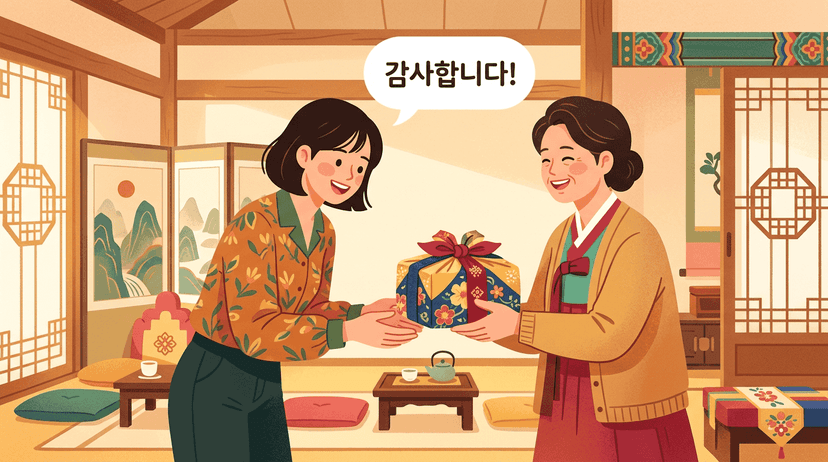
- Over-using 감사합니다 as a greeting: While gratitude is always welcome, 감사합니다 (thank you) is not a greeting. Start with hello, then add thanks if appropriate. (If you want to master gratitude expressions, see our complete guide to saying thank you in Korean.)
- Mixing formality levels in one conversation: Stick to one speech level throughout a conversation. Jumping between formal and casual is jarring to native speakers.
How to Practice Korean Greetings
Knowing greetings in theory is one thing — using them naturally is another. Here are practical ways to get comfortable with Korean greetings.
1. Start Every Study Session with a Greeting
Before you open your textbook or app, say 안녕하세요 out loud. This tiny habit trains your mouth muscles and makes the greeting feel automatic over time.
2. Practice with AI Conversation Partners
One of the most effective ways to practice Korean greetings in context is through AI conversation partners. Unlike flashcards, which only test isolated words, AI companions let you practice greetings in realistic scenarios — meeting someone new, running into a friend, answering a phone call, or greeting an elder. You get real-time feedback on whether you used the right formality level and can practice over and over without any social pressure. Apps like Chingu let you chat with AI Korean companions who respond naturally and correct your mistakes, making it a great way to build greeting habits before using them in the real world.
3. Watch K-Dramas with a Greeting Focus
Pick any K-drama episode and pay specific attention to how characters greet each other. Notice how greetings change based on the relationship — a student greeting a teacher versus greeting a classmate, or an employee greeting a boss versus a colleague. K-dramas are an excellent window into real Korean social dynamics.
4. Practice the Bowing Motion
Stand in front of a mirror and practice bowing while saying your greeting. It might feel awkward at first, but combining the physical bow with the spoken greeting helps both become natural. Korean greetings are a full-body experience — the words and the bow work together.
5. Role-Play Different Scenarios
Imagine specific situations and practice the appropriate greeting:
- You walk into a coffee shop — what do you say?
- You meet your Korean friend’s grandmother — what greeting and bow do you use?
- Your phone rings with an unknown number — how do you answer?
- You see a coworker on Monday morning — what do you say?
- You haven’t seen a friend in months — how do you greet them?
Quick Reference: Korean Greetings Cheat Sheet
| Greeting | Hangul | Formality | Use Case |
|---|---|---|---|
| Hello (standard) | 안녕하세요 | Polite | Most situations |
| Hello (very formal) | 안녕하십니까 | Formal | Business, speeches |
| Hi (casual) | 안녕 | Casual | Close friends, kids |
| Hello (phone) | 여보세요 | Neutral | Phone calls only |
| Nice to meet you | 만나서 반갑습니다 | Polite-Formal | First meetings |
| Nice to meet you (formal) | 처음 뵙겠습니다 | Formal | Formal first meetings |
| Have you eaten? | 밥 먹었어요? | Polite | Mealtime greeting |
| Long time no see | 오랜만이에요 | Polite | Reunions |
| Did you sleep well? | 안녕히 주무셨어요? | Polite | Morning (to elders) |
| Goodbye (to person leaving) | 안녕히 가세요 | Polite | When you stay |
| Goodbye (to person staying) | 안녕히 계세요 | Polite | When you leave |
| Happy New Year | 새해 복 많이 받으세요 | Polite | Lunar New Year |
Frequently Asked Questions About Korean Greetings
What is the most common way to say hello in Korean?
The most common way to say hello in Korean is 안녕하세요 (annyeonghaseyo). It is polite, works in nearly every situation, and can be used at any time of day. Whether you’re greeting a coworker, a shopkeeper, or someone you’ve just met, 안녕하세요 is always appropriate.
What does annyeonghaseyo literally mean?
안녕하세요 (annyeonghaseyo) literally means “Are you at peace?” or “Are you well?” The word 안녕 (annyeong) means peace or well-being, and 하세요 (haseyo) is a polite verb form meaning “do you do.” It’s similar in spirit to the English “How do you do?”
Is it okay to say 안녕 to everyone?
No. 안녕 (annyeong) is casual speech and should only be used with close friends, children, or people clearly younger than you who you have a comfortable relationship with. Using 안녕 with elders, strangers, or in professional settings is considered disrespectful. Use 안녕하세요 instead.
How do Koreans greet on the phone?
Koreans answer the phone with 여보세요 (yeoboseyo). This greeting is used exclusively for phone calls and should never be used in face-to-face conversation. After the initial 여보세요, the conversation switches to regular polite or casual speech depending on who is calling.
Do I have to bow when saying hello in Korean?
While a bow is not strictly required in all situations, it is strongly expected when greeting elders, superiors, or in formal settings. Even a slight head nod shows respect. Between close friends, a wave or nod is sufficient. When in doubt, a gentle 15–30° bow paired with 안녕하세요 is always a safe choice.
What is the difference between 안녕히 가세요 and 안녕히 계세요?
안녕히 가세요 (annyeonghi gaseyo) means “Go in peace” and is said by the person who is staying to the person who is leaving. 안녕히 계세요 (annyeonghi gyeseyo) means “Stay in peace” and is said by the person leaving to the person who is staying. If both people are leaving, they both say 안녕히 가세요.
How do you say “nice to meet you” in Korean?
The two most common ways are 만나서 반갑습니다 (mannaseo bangapseumnida) for polite-formal situations, and 처음 뵙겠습니다 (cheoeum boepgesseumnida) for very formal first meetings. The casual version is 만나서 반가워 (mannaseo bangawo).
Why do Koreans ask “Have you eaten?” as a greeting?
Asking 밥 먹었어요? (bap meogeosseoyo — “Have you eaten?”) is a traditional Korean greeting that shows care and concern for the other person’s well-being. It dates back to times when food scarcity was common. Today it functions like “How are you?” and doesn’t necessarily require a detailed answer about your actual meal.
Can I use English greetings in Korea?
While many young Koreans understand English greetings like “hi” and “hello,” using Korean greetings will always be better received. It shows respect for the culture and effort to connect on their terms. Even a simple 안녕하세요 from a foreigner is warmly appreciated.
What’s the best way to practice Korean greetings?
The best approach is to practice greetings in context, not just as isolated phrases. AI conversation apps let you simulate real greeting scenarios — meeting someone new, arriving at a workplace, or calling a friend — so you can build the instinct for which greeting to use when. Combine this with watching K-dramas to observe native speakers, and practice saying greetings out loud daily to build muscle memory. For more strategies, check out our Korean conversation practice tips.