Chingu
How to Say Happy Birthday in Korean: Every Way to Wish Someone Well (2026)
Learn how to say happy birthday in Korean with every phrase you need. From formal saengil chukahamnida to the Korean birthday song, master birthday wishes with Hangul, romanization, and cultural tips.
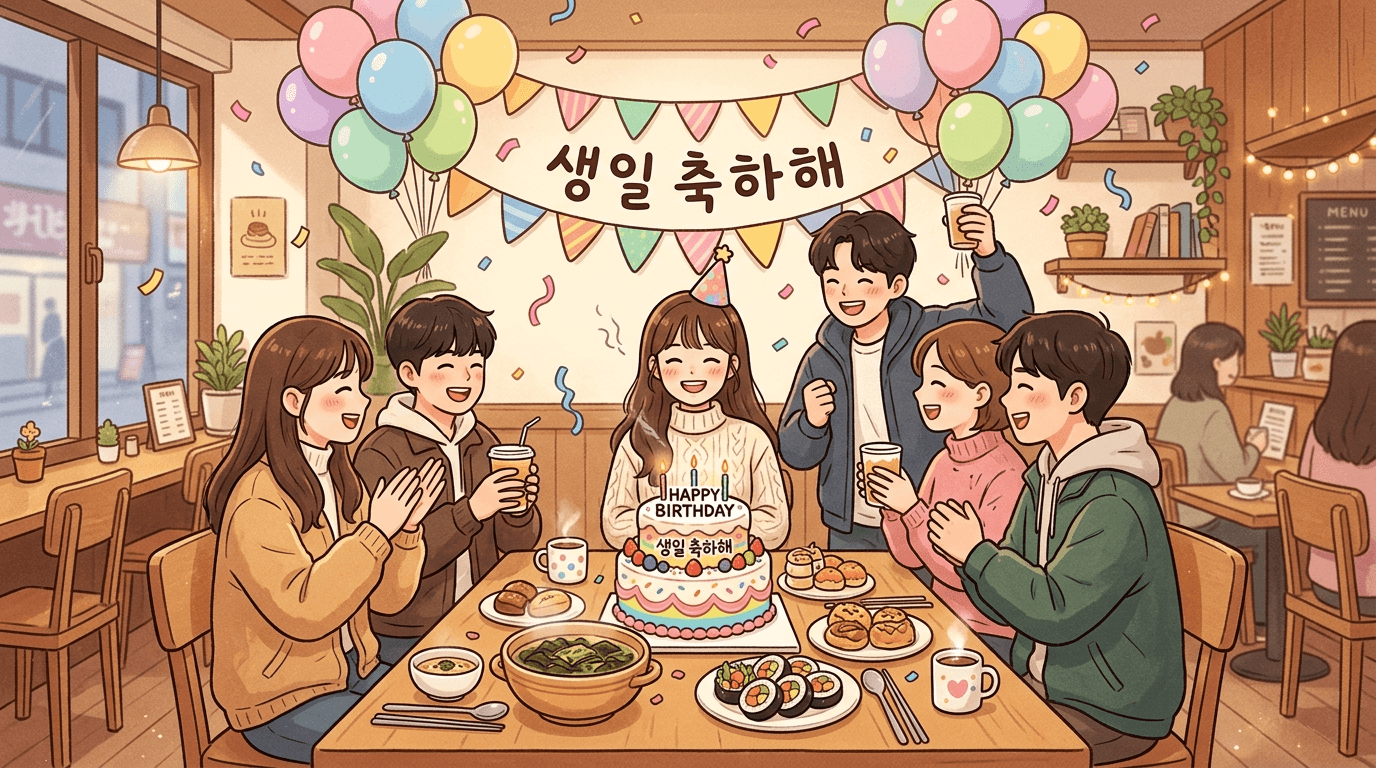
Whether you have a Korean friend, a K-pop bias whose birthday is coming up, or you simply want to expand your Korean vocabulary, knowing how to say happy birthday in Korean is one of those essential phrases that will come up again and again. Birthday celebrations in Korea are rich with cultural meaning — from the specific words you choose to the centuries-old traditions that surround milestone birthdays.
In this guide you’ll learn every way to say happy birthday in Korean, organized by formality level, along with the Korean birthday song lyrics, age-related customs, milestone birthday traditions, texting shortcuts, and how to respond when someone wishes you a happy birthday. Each entry includes the original Hangul, romanization, English translation, and clear guidance on when to use it. If you’re just starting your Korean journey, our beginner’s guide to learning Korean is a great companion to this post.
The Core Phrase: 생일 축하합니다 (Saengil Chukahamnida)
The standard, universally appropriate way to say happy birthday in Korean is 생일 축하합니다 (saengil chukahamnida). This is the phrase you’ll hear in the Korean birthday song, at office celebrations, and in polite company. If you only learn one way to wish someone a happy birthday in Korean, make it this one.
Breaking it down:
- 생일 (saengil) — birthday (생 means “birth,” 일 means “day”)
- 축하 (chuka) — congratulations, celebration
- 합니다 (hamnida) — formal polite verb ending meaning “do”
So 생일 축하합니다 literally translates to “I congratulate your birthday” or “I celebrate your birthday.” It is the formal polite form (합쇼체, hapsyoche) and is appropriate in virtually any situation — with strangers, elders, colleagues, teachers, and anyone you’re not on casual terms with.
Pronunciation tip: The ㅎ in 축하 softens slightly when spoken naturally. Listen carefully and you’ll hear it as saeng-il chu-ka-ham-ni-da, with the stress distributed evenly. The ㅂ in 합 nasalizes to an “m” sound before ㄴ, just like in 감사합니다 (gamsahamnida).
When to Use 생일 축하합니다
- Wishing a colleague or boss happy birthday at work
- Writing a birthday message to someone older than you
- Singing the Korean birthday song (more on this below)
- Posting a birthday greeting on someone’s social media when you’re not close friends
- Any situation where you’re unsure which formality level to use
Every Way to Say Happy Birthday in Korean (By Formality Level)
Just like Korean has multiple ways to say hello and say thank you, birthday wishes come in different formality levels. Choosing the right one depends on your relationship with the birthday person and the social context.
1. 생일 축하합니다 (Saengil Chukahamnida) — Formal Polite
Formality: High (formal polite / 합쇼체)
When to use: Colleagues, bosses, teachers, elders, strangers, formal events, the birthday song.
This is the gold standard. As described above, it works everywhere and is never inappropriate. Use this as your default unless you have a specific reason to go more casual.
Example sentences:
- 김 부장님, 생일 축하합니다! (Kim bujangnim, saengil chukahamnida!) — Happy birthday, Manager Kim!
- 할머니, 생일 축하합니다. 건강하세요. (Halmeoni, saengil chukahamnida. Geonganghaseyo.) — Happy birthday, Grandmother. Stay healthy.
2. 생일 축하해요 (Saengil Chukahaeyo) — Standard Polite
Formality: Medium (standard polite / 해요체)
When to use: Acquaintances, friendly colleagues, people slightly older than you, anyone you’re friendly with but not intimate.
생일 축하해요 is the standard polite form. It’s warm and friendly without being overly formal or stiff. This is the form most Koreans use in everyday birthday wishes when the relationship is cordial but not super close.
Example sentences:
- 언니, 생일 축하해요! 좋은 하루 보내세요. (Eonni, saengil chukahaeyo! Joeun haru bonaeseyo.) — Happy birthday, eonni! Have a great day.
- 생일 축하해요! 올해도 행복하세요. (Saengil chukahaeyo! Olhaedo haengbokhaseyo.) — Happy birthday! Be happy this year too.
3. 생일 축하해 (Saengil Chukahae) — Casual
Formality: Low (casual / 반말)
When to use: Close friends, younger siblings, romantic partners, children, anyone you use 반말 with.
생일 축하해 is the casual form — warm, affectionate, and intimate. This is what you’d say to your best friend, your younger sibling, or your partner. Using it with someone who expects polite speech would be rude, so be mindful of the relationship.
Example sentences:
- 야, 생일 축하해! 선물 준비했어. (Ya, saengil chukahae! Seonmul junbihaesseo.) — Hey, happy birthday! I prepared a gift.
- 생일 축하해~ 오늘 뭐 할 거야? (Saengil chukahae~ Oneul mwo hal geoya?) — Happy birthday~ What are you doing today?
4. 생신 축하합니다 / 생신 축하드립니다 (Saengsin Chukahamnida / Saengsin Chukadeurimnida) — Honorific
Formality: Very high (honorific)
When to use: Grandparents, elderly relatives, your partner’s parents, very senior figures, anyone deserving of the highest respect.
When the birthday person is significantly older or holds a position of great respect, Korean has an even more elevated option. The word 생신 (saengsin) is the honorific form of 생일 (saengil). Using 생신 instead of 생일 immediately elevates the respect level. Adding 축하드립니다 (chukadeurimnida) — which uses the humble verb 드리다 (deurida, “to give” humbly) — makes it even more respectful.
Example sentences:
- 아버님, 생신 축하드립니다. (Abeonim, saengsin chukadeurimnida.) — Happy birthday, Father (respectful, e.g., to father-in-law).
- 할아버지, 생신 축하드립니다. 항상 건강하세요. (Harabeoji, saengsin chukadeurimnida. Hangsang geonganghaseyo.) — Happy birthday, Grandfather. Always stay healthy.
Quick Reference Table: Korean Birthday Wishes
| Expression | Romanization | Formality | Best Used With |
|---|---|---|---|
| 생신 축하드립니다 | Saengsin chukadeurimnida | Very formal (honorific) | Grandparents, elderly, in-laws |
| 생일 축하합니다 | Saengil chukahamnida | Formal polite | Colleagues, teachers, strangers |
| 생일 축하해요 | Saengil chukahaeyo | Standard polite | Acquaintances, friendly colleagues |
| 생일 축하해 | Saengil chukahae | Casual | Close friends, younger people, partners |
| 생축 | Saengchuk | Slang (texting) | Close friends, online |
The Korean Birthday Song: 생일 축하 노래
Here’s the good news: the Korean birthday song uses the exact same melody as the English “Happy Birthday to You.” The tune is identical — only the words change. This means if you know the English melody, you already know the Korean one.
Here are the full lyrics:
- Line 1: 생일 축하합니다 (Saengil chukahamnida) — Happy birthday to you
- Line 2: 생일 축하합니다 (Saengil chukahamnida) — Happy birthday to you
- Line 3: 사랑하는 [name]의 (Saranghaneun [name]-ui) — Dear beloved [name]
- Line 4: 생일 축하합니다 (Saengil chukahamnida) — Happy birthday to you
In line 3, you insert the birthday person’s name. The word 사랑하는 (saranghaneun) means “beloved” or “dear,” and 의 (ui) is a possessive particle. So if your friend’s name is 지수 (Jisu), line 3 becomes “사랑하는 지수의” (saranghaneun Jisu-ui). If you’re curious about the word 사랑 (sarang, love) and its many uses, check out our guide to saying I love you in Korean.
Singing tip: The syllables map onto the melody more naturally than you might expect. Practice it a few times and you’ll notice that 생일 축하합니다 fits the rhythm perfectly. Many Koreans also clap along to the beat while singing.
After the song, the birthday person makes a wish, blows out the candles, and everyone cheers or applauds. This part of the celebration is virtually identical to Western birthday customs — Korea adopted the cake-and-candles tradition and made it their own.
Korean Birthday Customs and Traditions
Korean birthdays go far beyond cake and candles. Understanding the cultural context will help you celebrate appropriately — and impress your Korean friends with your knowledge.
미역국 (Miyeokguk) — Birthday Seaweed Soup
One of the most distinctly Korean birthday traditions is eating 미역국 (miyeokguk, seaweed soup) on your birthday. This isn’t optional or quaint — it’s deeply meaningful. Korean mothers eat miyeokguk after giving birth because the seaweed is rich in nutrients that aid recovery. Eating it on your birthday is a way of honoring your mother and the day she gave birth to you.
If a Korean friend asks you “미역국 먹었어?” (Miyeokguk meogeosseo? — Did you eat seaweed soup?) on your birthday, they’re essentially asking, “Did you celebrate your birthday properly?” Skipping miyeokguk on your birthday would feel incomplete to many Koreans.
Interestingly, miyeokguk also has a negative association: eating it before an exam is considered bad luck because the slippery seaweed symbolizes “slipping” or failing. So Koreans avoid it before tests but embrace it on birthdays.
Buying Treats for Others
In Western culture, friends typically buy the birthday person gifts and meals. In Korea, the tradition is often reversed — the birthday person buys treats for their friends, classmates, or coworkers. This might be a box of cakes, snacks, or a round of coffee for the office. It’s a way of sharing your happiness with the people around you.
This doesn’t mean Korean birthday people never receive gifts — close friends and family certainly give presents. But the tradition of the birthday person treating others is a distinctly Korean touch that surprises many foreigners.
Korean Age and Birthdays
If you’ve spent any time learning Korean, you’ve probably encountered the Korean age system. Traditionally, Koreans counted age differently from most of the world:
- You were considered 1 year old at birth (counting time in the womb).
- Everyone gained a year on January 1st, regardless of their actual birthday.
This meant a baby born on December 31st would be considered 2 years old the very next day. In June 2023, South Korea officially adopted the international age system for legal and administrative purposes, aligning with the rest of the world. However, the traditional Korean age system (called 한국 나이, hanguk nai) still lingers in everyday conversation and cultural contexts.
When someone asks your age in Korean, they might use the word 몇 살이에요? (myeot sarieyo? — How old are you?) and depending on the context, they may be thinking in Korean age or international age. For birthdays specifically, the actual birth date is what matters for celebrations.
Milestone Korean Birthdays
Certain birthdays carry enormous cultural significance in Korea. These milestone celebrations are deeply rooted in Korean tradition and are still widely observed today.
돌잔치 (Doljanchi) — First Birthday Celebration
The 돌잔치 (doljanchi) is a baby’s first birthday celebration and one of the most important events in Korean family life. Historically, infant mortality rates were high, so surviving to age one was a genuine milestone worth celebrating. While modern medicine has changed the stakes, the tradition remains deeply cherished.
The centerpiece of a doljanchi is the 돌잡이 (doljabi), a fortune-telling ritual where the baby is placed in front of a table with various objects. Whichever item the baby grabs first is said to predict their future:
- 실 (sil, thread/string): Long life
- 쌀 (ssal, rice) or 떡 (tteok, rice cake): A life of abundance, never going hungry
- 돈 (don, money): Wealth
- 연필 (yeonpil, pencil) or 책 (chaek, book): Academic success, becoming a scholar
- 마이크 (maikeu, microphone): A modern addition — becoming a celebrity or entertainer
- 공 (gong, ball): Another modern addition — becoming an athlete
The baby wears a traditional hanbok (한복), and the event is celebrated with family, friends, and lots of food. Modern doljanchi celebrations are often held at event halls or restaurants and can be quite elaborate.
환갑 (Hwangap) — 60th Birthday
환갑 (hwangap), also written as 회갑 (hoegap), marks the completion of one full cycle of the traditional 60-year calendar (based on the Chinese zodiac and heavenly stems). Turning 60 means you have lived through all 60 combinations of the cycle — a remarkable achievement, especially in earlier centuries when life expectancy was much shorter.
Traditionally, hwangap was the most lavish birthday celebration in Korean culture. Children would organize an elaborate feast for their parents, inviting extended family and friends. The 60-year-old would sit at a beautifully decorated table piled high with fruits, rice cakes, and other delicacies while receiving deep bows (큰절, keunjeol) from their children and grandchildren.
Today, since living to 60 is no longer unusual, hwangap celebrations have become somewhat less extravagant than they once were. Many families now hold a special dinner rather than a full traditional feast. However, some families still go all out, and the sentiment behind the celebration — honoring a parent’s long life — remains powerful.
칠순 (Chilsun) — 70th Birthday
As life expectancy increased, 칠순 (chilsun, 70th birthday) has taken on the level of importance that hwangap once held. Many Korean families now treat the 70th birthday as the “big one” and organize a major celebration with family gatherings, special meals, and heartfelt speeches. Some families combine the 70th birthday with a trip or other meaningful experience.
팔순 (Palsun) — 80th Birthday
팔순 (palsun, 80th birthday) is another significant milestone, celebrated with great respect and affection. Reaching 80 is seen as a true blessing, and the celebration is similar in spirit to chilsun — family-centered, respectful, and full of gratitude for the elder’s long life.
Birthday Wishes for Specific Situations
Beyond the basic “happy birthday,” here are phrases tailored to common situations you might encounter.
Adding Well-Wishes After “Happy Birthday”
Koreans often follow the birthday wish with an additional well-wish. Here are the most common pairings:
- 생일 축하해요! 행복한 하루 보내세요. (Saengil chukahaeyo! Haengbokan haru bonaeseyo.) — Happy birthday! Have a happy day.
- 생일 축하합니다! 건강하세요. (Saengil chukahamnida! Geonganghaseyo.) — Happy birthday! Stay healthy. (Especially common for older recipients.)
- 생일 축하해! 올해도 좋은 일만 가득하길. (Saengil chukahae! Olhaedo joeun ilman gadeukagil.) — Happy birthday! Wishing you only good things this year too.
- 생일 축하해요! 소원 다 이루세요. (Saengil chukahaeyo! Sowon da iruseyo.) — Happy birthday! May all your wishes come true.
- 생일 축하해! 사랑해. (Saengil chukahae! Saranghae.) — Happy birthday! I love you. (For close friends or romantic partners.)
Belated Birthday Wishes
Missed someone’s birthday? Here’s how to handle it:
- 늦었지만 생일 축하해요! (Neujeotjiman saengil chukahaeyo!) — It’s late, but happy birthday!
- 뒤늦게 생일 축하해! (Dwineutge saengil chukahae!) — Belatedly, happy birthday! (Casual)
Birthday Wishes for a Romantic Partner
- 내 사랑, 생일 축하해. 태어나줘서 고마워. (Nae sarang, saengil chukahae. Taeeonajwoseo gomawo.) — My love, happy birthday. Thank you for being born.
- 세상에서 제일 좋아하는 사람, 생일 축하해! (Sesangeseo jeil joahaneun saram, saengil chukahae!) — My favorite person in the world, happy birthday!
The phrase 태어나줘서 고마워 (taeeonajwoseo gomawo — “thank you for being born”) is a particularly popular and touching birthday message in Korean, often used between close friends and lovers alike.
Texting Birthday Wishes in Korean
Korean texting culture has its own abbreviated and playful ways to wish someone a happy birthday. If you’re messaging a Korean friend on KakaoTalk, knowing these will help your wishes feel natural:
- 생축! (Saengchuk!) — Abbreviated slang for 생일 축하 (saengil chuka). Very common in casual texts between friends.
- 생일 축하해요~ or 생일 축하해~ — Adding a tilde (~) at the end makes the message sound softer and friendlier, which is standard in Korean texting.
- ㅎㅂ — Short for 해피 버스데이 (haepi beoseudei, “happy birthday” in Konglish). Ultra-casual, used among very close friends.
- 해피 버스데이! (Haepi beoseudei!) — The full Konglish version of “happy birthday.” Young Koreans mix this in with Korean birthday wishes for a playful tone.
- 생일 축하축하! (Saengil chukachuka!) — Doubling 축하 for a cute, excited feel.
You’ll also frequently see birthday messages accompanied by KakaoTalk stickers and emojis — cake, party poppers, and heart emojis are standard. Many Koreans send a combination of a short text plus a carefully chosen sticker to convey warmth.
How to Respond to Birthday Wishes in Korean
When someone wishes you a happy birthday, knowing how to respond gracefully matters. Here are the most common replies:
고마워요 / 고마워 (Gomawoyo / Gomawo) — Thank You
The simplest and most common response. Use 고마워요 (polite) or 고마워 (casual) depending on your relationship with the person. For more formal situations, use 감사합니다 (gamsahamnida).
감사합니다 (Gamsahamnida) — Thank You (Formal)
Use this with elders, bosses, or anyone you’d normally use formal speech with. A response like “축하해 주셔서 감사합니다” (chukahae jusyeoseo gamsahamnida — “Thank you for congratulating me”) is a polished, appreciative reply.
Common Response Patterns
- 고마워! 덕분에 기분 좋아. (Gomawo! Deokbune gibun joa.) — Thanks! I feel great because of you. (Casual)
- 감사합니다! 좋은 하루 보내겠습니다. (Gamsahamnida! Joeun haru bonaegetsseumnida.) — Thank you! I’ll have a great day. (Formal)
- 고마워요~ 오늘 진짜 행복해요. (Gomawoyo~ Oneul jinjja haengbokhaeyo.) — Thank you~ I’m really happy today. (Polite)
- ㅎㅎ 고마워! (hehe gomawo!) — Hehe, thanks! (Texting, casual)
K-Pop Birthday Culture: 생일카페, 생일광고, and Fan Celebrations
K-pop has created an entirely new dimension of birthday culture in Korea. If you follow K-pop at all, you’ve likely encountered the elaborate fan-organized birthday celebrations that have become a defining feature of the industry.
생일카페 (Saengil Kape) — Birthday Cafes
생일카페 (saengil kape, birthday cafes) are temporary pop-up events organized by fan clubs at cafes in cities like Seoul. Fans reserve a cafe for a set period — often several days around an idol’s birthday — and transform it with decorations, custom cup sleeves, photo displays, free merchandise, and themed desserts, all celebrating the idol. Other fans visit the cafe to celebrate together, take photos, and share in the collective affection for their favorite artist.
Birthday cafes are most commonly found in the Hongdae, Gangnam, and Myeongdong areas of Seoul. They’re free to enter (you just buy a drink from the cafe), and visiting them has become a beloved ritual for K-pop fans visiting Korea.
생일광고 (Saengil Gwanggo) — Birthday Advertisements
생일광고 (saengil gwanggo, birthday advertisements) take fan celebrations to another level entirely. Fan clubs pool money to buy advertising space — on subway station screens, digital billboards, bus shelters, and even building facades — featuring their idol’s birthday message. Walking through a Seoul subway station around a popular idol’s birthday, you might see dozens of glowing screens wishing them well.
These advertisements can range from modest subway screen displays to massive LED billboards in places like Gangnam or Times Square in Yeongdeungpo. The scale of spending reflects the devotion of the fan base, and the practice has become so widespread that advertising companies now specifically market birthday ad packages to fan clubs.
Hashtag Culture and Online Celebrations
On social media, K-pop fans use birthday-related hashtags to trend their idol’s name worldwide. Common formats include:
- #[이름]_생일축하해 — #[Name]_saengilchukahae (Happy birthday [Name])
- #Happy[Name]Day — English-Korean hybrid hashtag
- #[이름]의_날 — #[Name]-ui_nal ([Name]’s day)
Fans also create fan art, video compilations, and charity donations in the idol’s name as birthday gifts. Donating to causes the idol cares about has become an increasingly popular way to celebrate, reflecting a positive trend in K-pop fan culture.
Common Mistakes to Avoid
Keep these pitfalls in mind when wishing someone a happy birthday in Korean:
- Using 생일 축하해 with elders: Never use the casual form with someone older than you, your boss, or anyone you should show respect to. Use 생일 축하합니다 or, for grandparents and senior figures, 생신 축하드립니다.
- Forgetting 생신 for elderly relatives: If you say 생일 축하합니다 to your Korean partner’s grandparent instead of 생신 축하드립니다, it might be perceived as lacking respect. The 생신 honorific makes a significant difference.
- Not knowing the birthday song lyrics: If you’re at a Korean birthday celebration and the song starts, mumbling through it will be noticeable. The lyrics are simple — learn them and sing along with confidence.
- Skipping the well-wish: A bare “생일 축하해요” is fine, but adding a follow-up wish like “행복한 하루 보내세요” (have a happy day) makes your greeting feel complete and thoughtful.
- Being surprised when the birthday person buys treats: Remember that in Korean culture, the birthday person often treats others. Don’t decline the gesture — accept it graciously and enjoy.
How to Practice Korean Birthday Wishes
The best way to make these phrases stick is to use them in context, not just memorize them from a list. Here are some practical approaches:
1. Follow K-Pop Birthday Calendars
There’s always a K-pop idol’s birthday coming up. Practice writing birthday messages in Korean on social media — even if you never post them, the act of composing the message reinforces the vocabulary and sentence patterns.
2. Sing the Korean Birthday Song
Seriously — sing it out loud. The melody is already in your head. Practicing the Korean lyrics builds muscle memory and pronunciation simultaneously. Sing it in the shower, in the car, wherever you won’t be embarrassed.
3. Practice with AI Conversation Partners
AI conversation apps let you simulate birthday scenarios where you need to choose the right formality level. You could practice wishing a virtual Korean friend happy birthday, responding to birthday wishes, or even role-playing a doljanchi celebration. This kind of contextual practice is far more effective than rote memorization. Apps like Chingu let you chat with Korean-speaking AI friends who respond naturally and help you build these skills through real conversation.
4. Set Calendar Reminders for Korean Friends
If you have Korean friends, set reminders for their birthdays and commit to sending your wishes in Korean. Real-world practice with real stakes (wanting to get it right for someone you care about) is the most powerful motivator there is.
Frequently Asked Questions About Korean Birthday Wishes
What is the most common way to say happy birthday in Korean?
The most common way is 생일 축하합니다 (saengil chukahamnida). It is the formal polite form and works in virtually every situation — from singing the birthday song to writing a message to a colleague. For casual situations with close friends, 생일 축하해 (saengil chukahae) is the go-to form.
What is the Korean birthday song?
The Korean birthday song uses the exact same melody as the English “Happy Birthday to You.” The lyrics are: 생일 축하합니다, 생일 축하합니다, 사랑하는 [name]의, 생일 축하합니다. You simply insert the birthday person’s name in the third line.
Why do Koreans eat seaweed soup on their birthday?
Koreans eat 미역국 (miyeokguk, seaweed soup) on their birthday because it is the traditional food given to mothers after childbirth due to its nutritional benefits. Eating it on your birthday honors your mother and the day you were born. It is one of the most deeply rooted Korean birthday traditions.
What is doljanchi?
돌잔치 (doljanchi) is a Korean baby’s first birthday celebration. The highlight is the 돌잡이 (doljabi) ritual, where the baby is placed before a table of objects and whichever item they grab is said to predict their future — thread for long life, money for wealth, a pencil for academic success, and so on.
What is the difference between 생일 and 생신?
생일 (saengil) is the standard word for birthday. 생신 (saengsin) is the honorific form, used when referring to the birthday of someone significantly older or of high social standing, such as grandparents, elderly relatives, or your partner’s parents. Using 생신 instead of 생일 shows an elevated level of respect.