Chingu
What Does Oppa Mean? Oppa, Hyung, Unnie, and Noona Explained (2026)
What does oppa mean in Korean? Learn the real meaning of oppa, hyung, unnie, and noona — the four sibling-style words K-drama and K-pop fans hear constantly. Includes Hangul, romanization, age rules, romantic usage, and when not to use them.
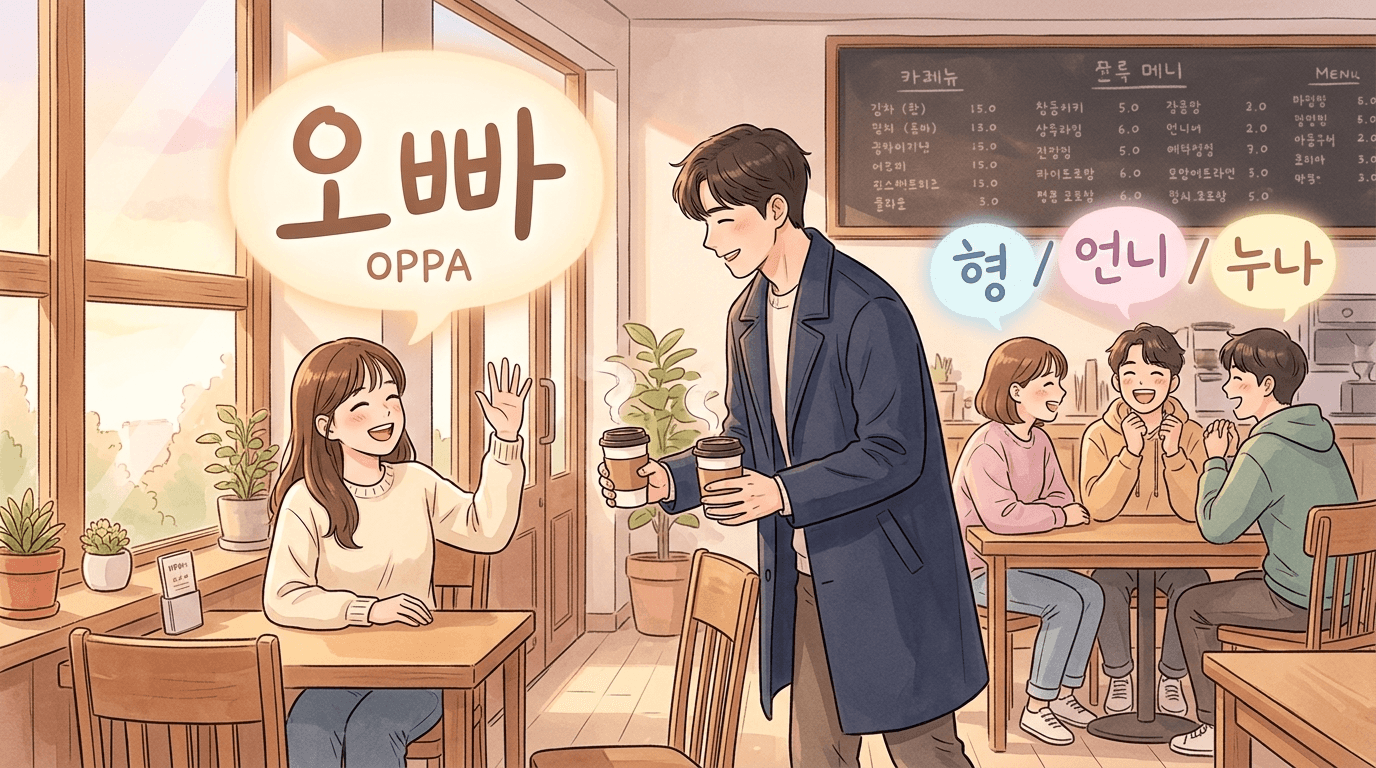
If you’ve spent any amount of time watching K-dramas, listening to K-pop, or scrolling through Korean variety shows, you’ve heard the word oppa (오빠) probably a hundred times in a single afternoon. You’ve heard characters call each other hyung (형), unnie (언니), and noona (누나) too — sometimes between actual siblings, sometimes between friends, sometimes between people who are clearly flirting, and sometimes between strangers who just met. So what do these words actually mean, and why do Koreans use them constantly?
This guide explains all four words from the ground up — what each one means, who says it to whom, the age and gender rules that govern their use, the romantic undertones that show up in K-dramas, and the unwritten cultural logic behind why Koreans rarely use first names the way English speakers do. By the end, you’ll know exactly what your K-drama bias is saying and why. If you’re newer to the language, our beginner’s guide to learning Korean is a great place to build foundation before you dive into honorifics like these.
Quick Answer: What Do Oppa, Hyung, Unnie, and Noona Mean?
The shortest possible explanation is this: these four words all mean “older sibling,” but which one you use depends entirely on (a) your gender and (b) the gender of the older person. Native Korean does not have a single neutral word for “older brother” or “older sister” the way English does — instead, the speaker’s gender decides the word.
- 오빠 (oppa) — what a female calls an older male
- 형 (hyung) — what a male calls an older male
- 언니 (unnie / eonni) — what a female calls an older female
- 누나 (noona) — what a male calls an older female
Importantly, these aren’t reserved for actual blood relatives. Koreans use them constantly with close friends, classmates, coworkers, romantic partners, and even celebrities they’ve never met. They’re affectionate, relational terms that signal closeness and acknowledge the age gap between speakers — which, as you’ll see, matters far more in Korean culture than it does in most Western cultures.
What Does Oppa (오빠) Mean?
오빠 (oppa) literally means “older brother,” but only when a female is the one speaking. A woman calls her biological older brother oppa. She also calls older male friends oppa, older male coworkers oppa, her boyfriend oppa (if he’s older), and the male K-pop idols she stans oppa (regardless of whether she’s ever met them).
Pronunciation matters here: it’s romanized as “oppa” but the double-p (ㅃ) is a tense consonant, slightly sharper than an English “p.” The stress sits on the first syllable: OH-pa.
Oppa in Family Context
The original, oldest use is purely familial. A younger sister calls her older brother oppa, often paired with his name or just by itself:
- 오빠, 어디 가? (Oppa, eodi ga?) — Oppa, where are you going?
- 우리 오빠는 의사예요. (Uri oppa-neun uisa-yeyo.) — My older brother is a doctor.
Notice that 우리 (uri, “our”) is often attached to family terms in Korean even when only one person is speaking. “Uri oppa” literally means “our older brother” but is the natural way to say “my older brother.”
Oppa with Friends and Acquaintances
This is where oppa becomes confusing for non-Korean speakers. Korean culture discourages using first names for people older than you — it can come across as rude or overly familiar. So a woman talking to a male friend, classmate, or coworker who is even one year older will typically call him oppa instead of his name.
- 민준 오빠 (Minjun oppa) — older male friend named Minjun
- 오빠, 이거 도와줄 수 있어요? (Oppa, igeo dowajul su isseoyo?) — Oppa, can you help me with this?
The relationship has to be close enough that calling him oppa feels natural — you wouldn’t call your boss oppa, for example. For workplace seniors, the word 선배 (sunbae) is used instead.
Oppa in Romantic Relationships
Here is the most famous use of oppa, and the one K-drama fans probably know best. When a Korean woman has an older boyfriend, she almost always calls him oppa — even after they’re married in some cases. It’s affectionate, intimate, and culturally normal.
- 오빠, 사랑해. (Oppa, saranghae.) — Oppa, I love you.
- 오빠, 보고 싶어. (Oppa, bogo sipeo.) — Oppa, I miss you.
If you want a deeper look at how Koreans express affection, our guide to how to say I love you in Korean covers every variation and the contexts where each fits.
The romantic connotation is so strong that in modern Korean media, simply having a female character call a man oppa can signal a romantic interest — even before any confession scene. This is why K-drama love triangles often involve a female lead suddenly switching from a name to “oppa” or vice versa: the word change is the plot point.
Oppa in Fan Culture
Female K-pop fans call their male idols oppa as a sign of affection and parasocial closeness — even when there’s no actual relationship and the idol might be the same age or younger than the fan. This usage has become so widespread that it’s essentially its own fan-culture phenomenon. You’ll see comments like “오빠 사랑해!” (Oppa, I love you!) flooding any K-pop music video.
Interestingly, calling a younger male idol oppa is technically incorrect, but fans do it anyway as an expression of affection. Idols themselves sometimes lean into this: variety shows are full of bits where younger members jokingly ask older members to call them oppa.
Important: Men Do Not Use Oppa
A common beginner mistake is for male learners to call their older male friends “oppa.” This is incorrect and will get you puzzled looks. Men use hyung (형) instead — covered next.
What Does Hyung (형) Mean?
형 (hyung) is the male counterpart to oppa. It means “older brother,” used by a male speaker addressing an older male. So a younger brother calls his biological older brother hyung. A male friend calls his older male friends hyung. Male coworkers, classmates, gym buddies, and bandmates all get hyung if they’re older and the relationship is friendly.
Pronunciation: the ㅎ is a soft “h” sound, the ㅕ is “yuh,” and the ㅇ at the end is the “ng” sound. So hyuhng, almost rhyming with English “tongue.”
Hyung in Family Context
- 형, 밥 먹었어? (Hyung, bap meogeosseo?) — Hyung, have you eaten?
- 우리 형은 회사원이에요. (Uri hyung-eun hoesawon-ieyo.) — My older brother is an office worker.
Hyung Among Male Friends
Hyung is used heavily among male friend groups, especially in school, military, sports teams, and workplaces with close-knit junior/senior dynamics. K-pop boy groups are a perfect example: members refer to the older members as “[name] hyung” constantly in interviews and variety shows.
- 지민 형 (Jimin hyung) — older bandmate named Jimin (said by a younger male member)
- 형, 같이 갈래? (Hyung, gachi gallae?) — Hyung, want to go together?
Hyung Without Romantic Implications
Unlike oppa, hyung carries no romantic undertone — it’s strictly a same-gender brotherly term. You’ll occasionally see it in queer contexts in modern Korean media, but in mainstream usage, hyung is the warm, masculine word for “older guy I look up to.”
What Does Unnie (언니) Mean?
언니 (eonni, often romanized as “unnie”) means “older sister,” used by a female speaker addressing an older female. A younger sister calls her biological older sister unnie. A woman calls her older female friends, classmates, and coworkers unnie. Female K-pop fans call older female idols unnie. The pattern mirrors oppa exactly, just for female-to-female relationships.
The standard romanization is “eonni,” but you’ll see “unnie” everywhere online — especially in K-pop fan spaces — because it better reflects the actual pronunciation: UH-nee.
Unnie in Family Context
- 언니, 뭐 해? (Eonni, mwo hae?) — Unnie, what are you doing?
- 우리 언니는 선생님이에요. (Uri eonni-neun seonsaengnim-ieyo.) — My older sister is a teacher.
Unnie Among Female Friends
Female friend groups, K-pop girl groups, female celebrities, and women in any close professional setting use unnie heavily. It’s warm, supportive, and slightly admiring — calling someone unnie often implies you respect her or look up to her.
- 수진 언니 (Sujin eonni) — older female friend named Sujin
- 언니, 이 옷 예쁘다! (Eonni, i ot yeppeuda!) — Unnie, this outfit is pretty!
Unnie in Business and Service Contexts
One quirky use: in restaurants and cafés, younger female customers sometimes call female servers unnie as a friendly, informal way to get their attention. This is much warmer than the more standard 저기요 (jeogiyo, “excuse me”) and works best in casual eateries, not fine dining.
What Does Noona (누나) Mean?
누나 (noona) means “older sister,” used by a male speaker addressing an older female. This is the term that K-drama fans probably hear least often in dramas about romance, because the most popular K-drama pairings are older-male/younger-female — but noona shows up constantly in family scenes, friend groups, and the famously beloved “noona romance” subgenre.
Pronunciation: NOO-na, with a clean “n” sound on both syllables. Short and warm.
Noona in Family Context
- 누나, 같이 가자. (Noona, gachi gaja.) — Noona, let’s go together.
- 우리 누나가 요리를 잘해요. (Uri noona-ga yori-reul jalhaeyo.) — My older sister is good at cooking.
Noona in Romance: The “Noona Romance” Trope
When a younger male character calls a slightly older female love interest noona, K-drama fans know exactly what’s coming — the “noona romance” trope. Famous examples include Something in the Rain, My Mister, and parts of Reply 1988. The age gap is often small (one to five years), but the dynamic is culturally distinct: the male lead initially uses noona deferentially, and the moment he drops the title or starts saying her name is treated as a major emotional turning point.
- 누나, 좋아해요. (Noona, joahaeyo.) — Noona, I like you.
The Korean Age Hierarchy: Why These Words Exist
To use these terms naturally, you have to understand the deeper logic: Korean culture is built around age hierarchy in a way that English-speaking cultures simply are not. When two Koreans meet, one of the first things they establish — explicitly or implicitly — is who is older. Age determines speech level, seating, who pours drinks for whom, and which forms of address are appropriate.
This is why Korean has so many honorifics and relational terms layered on top of names. Using someone’s bare first name without a title can feel cold, rude, or overly intimate depending on the relationship. Oppa, hyung, unnie, and noona are the warm, in-between solution: they acknowledge the age gap without being stiffly formal like 선생님 (seonsaengnim, “teacher/sir”) or 씨 (-ssi, the polite name suffix).
This same hierarchy logic is why our guide to Korean greetings spends so much time on formality levels — the choice between 안녕하세요 and 안녕 is the same logic as the choice between calling someone by name or calling them oppa.
What If You’re the Same Age?
If two Koreans determine they’re the same age (동갑, donggap), they typically switch to first names and casual speech (반말, banmal). Same-age friends are called 친구 (chingu), which is the actual word for “friend.” Calling someone slightly older “chingu” would be technically incorrect — you’d use oppa or unnie instead, even if you consider them a friend.
What If They’re Younger?
Older people speaking to younger people don’t use sibling-style terms back. Instead, they typically use the younger person’s name with the diminutive suffix 아/야 (-a/-ya), or a more general term like 동생 (dongsaeng, “younger sibling”). So an oppa-noona relationship is asymmetric: the younger person uses the title, the older person uses the name.
Related Terms You’ll Hear in K-Dramas
Once you understand the four core sibling terms, a few adjacent words will start making more sense.
선배 (Sunbae) — Senior at School or Work
선배 (sunbae) refers to someone senior to you in a specific institution — school, university, company, sports club. It’s gender-neutral and used by both men and women. In K-dramas, the office romance “sunbae” is a recurring archetype: the cool, capable senior the main character looks up to.
후배 (Hubae) — Junior at School or Work
후배 (hubae) is the opposite of sunbae — someone junior to you in the same institution. You rarely call someone “hubae” to their face the way you’d say “sunbae” — it’s more of a descriptive term used about someone.
동생 (Dongsaeng) — Younger Sibling / Younger Person
동생 (dongsaeng) means “younger sibling” and is gender-neutral. Korean speakers often use it descriptively about younger friends or coworkers: “우리 회사 동생” (uri hoesa dongsaeng) means “the younger person at our company.”
아저씨 / 아줌마 (Ajeossi / Ajumma) — Older Man / Older Woman
아저씨 (ajeossi) and 아줌마 (ajumma) are used for middle-aged men and women, typically strangers. These are not affectionate — calling someone ajumma when she doesn’t consider herself one can come across as rude.
Common K-Drama Lines Using These Words
Here are some lines you’ll recognize instantly if you’ve watched any K-dramas:
- 오빠, 미쳤어? (Oppa, michyeosseo?) — Oppa, are you crazy?
- 오빠가 좋아? 내가 좋아? (Oppa-ga joa? Naega joa?) — Do you like oppa? Or me? (Classic love-triangle line)
- 형, 진짜 미안해. (Hyung, jinjja mianhae.) — Hyung, I’m really sorry.
- 언니, 나 어떡해? (Eonni, na eotteokhae?) — Unnie, what do I do?
- 누나, 나랑 사귀자. (Noona, narang sagwija.) — Noona, let’s date.
Many of these short, emotional expressions also show up in our broader guide to Korean slang from K-dramas — words like 미쳤어, 어떡해, and 진짜 are essential K-drama vocabulary on their own.
When Not to Use Oppa, Hyung, Unnie, or Noona
These terms are warm and informal, which means there are situations where they’re wrong:
- Formal business contexts. Don’t call your boss oppa or your senior colleague hyung in a meeting. Use 선배님 (sunbaenim) or job titles instead.
- With people you just met. Even if they’re older, calling a stranger oppa is presumptuous. Wait until the relationship warms up.
- When the age gap is too large. Calling someone twenty years older oppa or unnie can feel strange. For much older people, 아저씨/아줌마 or other terms fit better.
- To non-Koreans. Unless they’ve specifically welcomed it or are deeply embedded in Korean culture, defaulting to these terms with non-Korean friends can feel forced or performative.
How to Practice Using These Terms Naturally
The hardest part of using oppa/hyung/unnie/noona isn’t the meaning — it’s the social intuition for when each one fits. K-drama watching helps, but passive watching only gets you so far. You need to actually speak Korean with people, hear yourself use these terms, and get feedback when you misuse them.
This is one of the areas where AI conversation practice shines. Apps like Chingu let you chat with Korean-speaking friend characters at different ages and relationship levels — so you can practice calling an older male friend oppa, an older female mentor unnie, and a same-age friend by name, all in the same week, without the social pressure of a real conversation. Our Korean conversation practice guide goes deeper into how to build this kind of relational fluency.
Frequently Asked Questions
What does oppa mean in Korean?
오빠 (oppa) means “older brother” in Korean, but only when a female is the one speaking. A woman calls her biological older brother oppa, but she also uses it for older male friends, older male coworkers, an older boyfriend or husband, and male K-pop idols she’s a fan of. Men do not use oppa — they use hyung (형) instead.
Can a man call another man oppa?
No. Oppa is exclusively used by female speakers addressing older males. A man calling another man oppa would sound very strange to a native Korean speaker. The correct word for a man to call an older male is 형 (hyung). The only exception is comedic or queer-coded contexts in modern Korean media, where the convention is intentionally subverted for effect.
Does oppa always mean boyfriend?
No. Oppa simply means “older male,” and a woman uses it for many different relationships — her actual older brother, older male friends, older male coworkers, and so on. However, in romantic contexts, calling a boyfriend or husband oppa is extremely common, which is why many non-Korean speakers associate the word with romance. The meaning depends entirely on context.
What is the difference between unnie and noona?
Both mean “older sister,” but the speaker’s gender decides which one is used. 언니 (unnie / eonni) is used by female speakers addressing older females. 누나 (noona) is used by male speakers addressing older females. So a younger sister calls her older sister unnie, but a younger brother calls the exact same older sister noona.
Can I call a Korean person oppa or unnie if I just met them?
It depends on how close you’re becoming and the social context. In casual settings — meeting an older Korean person at a language exchange, a study group, or through mutual friends — switching to oppa or unnie after a short conversation is normal and even welcomed. In more formal contexts like work or with someone significantly older, it’s better to wait until they suggest it or to stick with 선배 (sunbae) or honorific titles.
Why do K-pop fans call idols oppa even if the idol is younger?
This is a fan-culture quirk that started with female fans of male idols and stuck. Technically, calling a younger male oppa is incorrect — you should use his name or a different term. But in fan culture, oppa has become an expression of affection and parasocial attachment that overrides the strict age rule. Many idols even joke about being called oppa by older fans during fan meetings.