Chingu
30 Things a Korean Boyfriend Says (Sweet Phrases With Meaning)
30 sweet things a Korean boyfriend says, from 밥 먹었어? to 자기야, with romanization, what each one means, when he says it, and how to reply in Korean.

K-dramas give us the big romantic moments: the confession in the rain, the goodbye at the airport, the first 사랑해. Real Korean boyfriends say sweet things too, but most of them are much smaller. He asks if you have eaten. He tells you to text him when you get home. He calls just to hear your voice.
This list collects 30 of those phrases, grouped by the moments he says them, from the first text of the morning to the last call of the night. Each one has the Hangul, the romanization, what it means and when he says it. Every couple is different, of course, but whether you are dating a Korean man or simply love Korean romance, these are the lines you will hear again and again.
Quick Answer: The Phrases You Will Hear Most
Most of what a Korean boyfriend says is short, caring and in casual Korean (반말, banmal). He checks that you ate, slept and got home safely, and he tells you he misses you. These ten come up again and again:
| Korean | Romanization | Meaning |
|---|---|---|
| 밥 먹었어? | bap meogeosseo? | Did you eat? |
| 잘 잤어? | jal jasseo? | Did you sleep well? |
| 뭐 해? | mwo hae? | What are you doing? |
| 도착하면 연락해 | dochakamyeon yeollakae | Text me when you get there |
| 오늘도 수고했어 | oneuldo sugohaesseo | You worked hard today, too |
| 내가 데리러 갈게 | naega derireo galge | I’ll come pick you up |
| 보고 싶어 | bogo sipeo | I miss you |
| 잘 자 | jal ja | Good night |
| 사랑해 | saranghae | I love you |
| 자기야 | jagiya | Honey, babe |
Everyday Questions That Really Mean “I Care”
Many of the sweetest Korean phrases never say “I love you” at all. They sound like small questions, and they arrive many times a day.
1. 밥 먹었어? (bap meogeosseo?): Did you eat?
The most Korean way to check on someone. It is less about food and more about “are you okay?” After a busy day it becomes 밥은 먹었어? (babeun meogeosseo?), “did you at least eat?”
2. 잘 잤어? (jal jasseo?): Did you sleep well?
Often the first text of the morning, usually next to 좋은 아침 (joeun achim), “good morning.”
3. 뭐 해? (mwo hae?): What are you doing?
The message he sends when he has nothing to say except that he is thinking of you. It rarely needs a detailed answer.
4. 도착하면 연락해 (dochakamyeon yeollakae): Text me when you get there
연락 (yeollak) means any kind of contact, a text or a call. He wants to know you got home safely. Forget, and you will get 집에 잘 들어갔어? (jibe jal deureogasseo?), “did you get home okay?”
5. 따뜻하게 입어 (ttatteutage ibeo): Dress warmly
Said on cold mornings, before a night out, or any time he thinks your coat is too thin. It is one more way to say “I love you” without the words.
When You Had a Long Day
In the evening, a Korean boyfriend often starts with 퇴근했어? (toegeunhaesseo?), “are you off work yet?” These are the lines that come next.
6. 오늘도 수고했어 (oneuldo sugohaesseo): You worked hard today, too
수고 means effort and 도 means “too,” so this is “another long day, and you did it.” It is close to “good job today,” and he will say it often.
7. 오늘 많이 힘들었지? (oneul mani himdeureotji?): Today was hard, wasn’t it?
The 지 at the end means he already knows the answer. He is not asking for a report. He is telling you he noticed.
8. 내가 데리러 갈게 (naega derireo galge): I’ll come pick you up
The ㄹ게 ending turns a verb into a promise. You hear it after a late night at the office, or when it suddenly starts to rain.
9. 힘들면 나한테 기대 (himdeulmyeon nahante gidae): Lean on me when it’s hard
기대다 (gidaeda) means to lean, on a shoulder or on a person. It is a quiet, steady kind of sweet.
Phone Calls and Good Night
Night calls come with their own small rituals, from the reason he called to the long goodbye.
10. 목소리 듣고 싶어서 (moksori deutgo sipeoseo): I just wanted to hear your voice
His answer when you ask why he called. The full sentence is 목소리 듣고 싶어서 전화했어 (moksori deutgo sipeoseo jeonhwahaesseo), “I called because I wanted to hear your voice.”
11. 먼저 끊어 (meonjeo kkeuneo): You hang up first
Neither of you wants to end the call, so he insists you go first. Expect a few rounds of 너 먼저 끊어 (neo meonjeo kkeuneo), “no, you first,” before anyone actually hangs up.
12. 잘 자 (jal ja): Good night
Literally “sleep well,” and the last words of almost every night call. The sweeter versions are 잘 자, 내 사랑 (jal ja, nae sarang), “good night, my love,” and 내 꿈 꿔 (nae kkum kkwo), “dream of me.”
13. 네가 잠들 때까지 있을게 (nega jamdeul ttaekkaji isseulge): I’ll stay until you fall asleep
For the nights you cannot sleep. He stays on the line, talking softly, until you drift off.
When He Misses You
In Korean, “I miss you” is literally “I want to see you,” and he will tell you so in a few different ways.
14. 보고 싶어 (bogo sipeo): I miss you
The everyday way to say it. When you finally meet, it becomes 보고 싶었어 (bogo sipeosseo), “I missed you.” Our guide on how to say I miss you in Korean covers every version.
15. 벌써 보고 싶다 (beolsseo bogo sipda): I miss you already
Sent a few minutes after a date ends, often from the subway home. The plain 다 ending makes it sound like he is thinking out loud.
16. 지금 갈까? (jigeum galkka?): Should I come over now?
His reply when you tell him 보고 싶어 late in the evening. The bolder version skips the question: 지금 갈게 (jigeum galge), “I’m coming now.”
17. 영상통화 할까? (yeongsang tonghwa halkka?): Want to video call?
For long distance couples and the days you cannot meet. A regular phone call is just 전화 (jeonhwa).
Compliments and Big Feelings
Some lines are made to make you blush, and a few are made to last.
18. 왜 이렇게 예뻐? (wae ireoke yeppeo?): Why are you so pretty?
Not really a question. He says it when you are just sitting there, and the only answer he expects is a smile. 예뻐 (yeppeo) on its own means “you’re pretty.”
19. 사랑해 (saranghae): I love you
The big one. Some couples say it every day, others save it for special moments. A sweet morning version is 오늘도 사랑해 (oneuldo saranghae), “I love you today, too.” See every way to say I love you in Korean.
20. 너밖에 없어 (neobakke eopseo): You’re the only one
Literally “there is no one but you.” A compliment and a promise in one line.
21. 우리 오래가자 (uri oraegaja): Let’s be together for a long time
Often said on anniversaries. Korean couples count the days from the day they started dating, and the 100th day, 100일 (baegil), is a big one.
When He Gets a Little Jealous
K-dramas love a jealous male lead, and real boyfriends have their moments too.
22. 걔 누구야? (gyae nuguya?): Who’s that?
걔 is a casual word for “that person.” It comes out when a name he does not know pops up on your phone.
23. 나 질투 나 (na jiltu na): I’m jealous
질투 means jealousy, and plenty of Korean boyfriends simply admit it, half joking and half pouting. In the past tense it is 질투 났어 (jiltu nasseo), “I got jealous.”
24. 나만 봐 (naman bwa): Look only at me
Said with a pout when your attention drifts to your phone, or to a handsome actor on TV.
A little playful jealousy is sweet. Rules about who you can see or text are not, in any language.
Clingy Moments: When He Does 애교 (Aegyo)
애교 (aegyo) means acting cute on purpose: a softer voice, stretched out words, a little pout. It is not only for K-pop idols. Plenty of Korean men turn it on for their girlfriend.
25. 안아 줘 (ana jwo): Hug me
Usually said with his arms already open. Adding 줘 (jwo) turns a verb into “do it for me,” so you will also hear 손 잡아 줘 (son jaba jwo), “hold my hand.”
26. 가지 마 (gaji ma): Don’t go
In dramas it comes with a wrist grab. In real life it comes at the end of a date, often with 조금만 더 있다 가 (jogeumman deo itda ga), “stay a little longer.”
27. 칭찬해 줘 (chingchanhae jwo): Praise me
For when he has cooked dinner or finished something hard and wants you to notice. It often comes with 나 잘했지? (na jalhaetji?), “I did well, right?”
Pet Names He Calls You
Pet names are a big part of how Korean couples talk. These are the ones you are most likely to hear.
28. 자기야 (jagiya): Honey, babe
The most common pet name between Korean couples, and both partners use it. You will hear it in almost every K-drama romance.
29. 우리 애기 (uri aegi): My baby
애기 is the cute, spoken form of 아기 (agi, baby), and 우리 (uri, our) is how Koreans say “my” about someone close. You often hear it as 잘 자, 우리 애기, “good night, my baby.”
30. 여보 (yeobo): Honey
Mostly used by married couples. When a boyfriend says it, he is usually teasing you, or hinting at the future.
Other names you may hear: 내 사랑 (nae sarang, my love), 공주님 (gongjunim, princess), 예쁜이 (yeppeuni, pretty one) and 귀요미 (gwiyomi, cutie).
Why He Speaks Casual Korean, and What 오빠 and 자기야 Mean
Korean has speech levels. With strangers, coworkers and anyone older, people use polite speech, 존댓말 (jondaenmal), which often ends in 요. With people they are close to, they switch to 반말 (banmal), casual speech without 요. Most couples speak 반말 to each other, which is why none of the phrases above end in 요.
The switch itself can be a sweet moment. One of them asks 말 놓을까? (mal noeulkka?), “shall we speak casually?”, and from then on they talk like a couple. In K-dramas, the first time two characters drop 요 with each other is often a turning point.
What 오빠 means
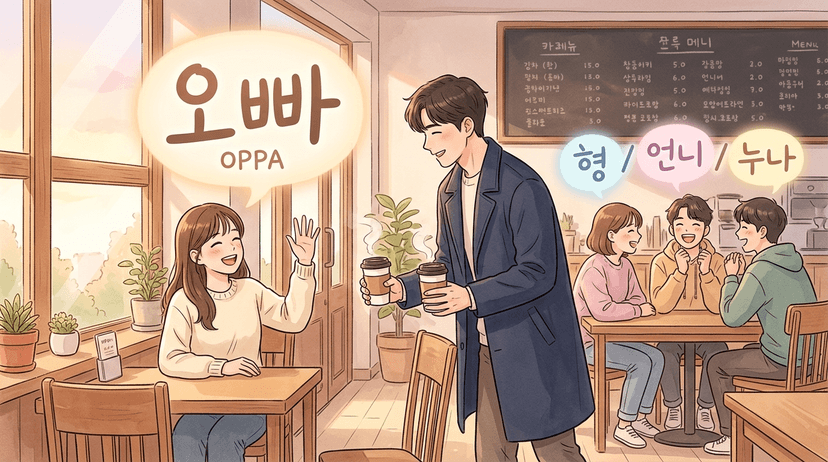
오빠 (oppa) is what a woman calls an older man she is close to: her brother, an older friend, and very often her boyfriend. Many women call an older boyfriend 오빠 instead of his name, and he may even use it for himself, as in 오빠가 데리러 갈게 (oppaga derireo galge), “oppa will come pick you up.” Read what oppa really means for the full picture.
What 자기야 means
자기 (jagi) literally means “oneself,” but between couples it means “honey.” The 야 ending is what you add when calling someone. Unlike 오빠, it does not depend on age or gender, so both partners can use it. Many couples mix the two: she calls him 오빠 or 자기야, and he calls her 자기야 or one of the pet names above.
How to Reply to Him in Korean
The easiest reply is 나도 (nado), “me too.” Put it in front of most sweet lines and you are done. A few more:
- 나도 보고 싶어 (nado bogo sipeo): I miss you too.
- 나도 사랑해 (nado saranghae): I love you too.
- 응, 먹었어. 오빠는? (eung, meogeosseo. oppaneun?): Yes, I ate. What about you? With an older boyfriend, many women use 오빠 in place of “you.”
- 도착했어 (dochakaesseo): I got here safely.
- 오빠도 수고했어 (oppado sugohaesseo): You worked hard today, too.
- 잘 자, 자기야 (jal ja, jagiya): Good night, honey.
Want more lines from the screen? Our list of Korean drama phrases covers the ones you hear in almost every episode.
Practice Saying Them Out Loud
Reading these phrases is the easy part. Saying them back, with the right warmth and at the right moment, takes a little practice. In Chingu, you can practice lines like these on a voice call with an AI Korean friend, for example Junho, a fictional K-drama actor. He picks up, speaks first in Korean with subtitles on screen, and you tap the mic to answer. He corrects you gently as you go and explains in English.
Chingu is free to start on iPhone. Maybe tonight, try ending a call with 잘 자.