Chingu
What Does Aigoo Mean? The Korean Sigh Word Explained (2026)
What does aigoo mean in Korean? Learn how 아이고 — the all-purpose Korean sigh word — expresses frustration, affection, surprise, and grief all at once. With Hangul, pronunciation, K-drama examples, and cultural context.
If you’ve watched any K-drama featuring a Korean grandmother — or really any K-drama at all — you’ve heard a character heave a long “아이고” (aigoo). It comes out when a character is tired, frustrated, surprised, relieved, amused, heartbroken, or simply seeing a grandchild after a long absence. It is one of the most-used sounds in spoken Korean, and yet textbooks barely teach it, because it sits somewhere between a word, a sigh, and a cultural reflex.
This guide explains exactly what 아이고 means, why Koreans use it constantly, the dozen-plus emotions it can express, how to pronounce it, the spelling variations (아이고 vs. 아이구 vs. 아이쿠), and the K-drama scenes where you’ll recognize it instantly. By the end, you’ll be able to use aigoo the way Koreans actually do — which is everywhere, all the time. If you’re building out your K-drama vocabulary, this pairs well with our guides to what daebak means and what oppa, hyung, unnie, and noona mean.
Quick Answer: What Does Aigoo Mean?
아이고 (aigoo, sometimes spelled aigo or aigu) is a Korean interjection with no direct English equivalent. The closest translations depend entirely on context:
- “Oh my”
- “Oh goodness”
- “Oof”
- “Ugh”
- “Aww”
- “Geez”
- “Oh dear”
- “Whew”
It is closer to a sigh or a verbal sound than a word with a specific meaning. Aigoo is what a Korean speaker says when they sit down at the end of a long day, when they stub their toe, when they see a cute baby, when they hear bad news, when they’re mildly exasperated with someone they love — basically any moment that calls for an emotional release. Tone and context tell the listener which feeling is in play.
The Literal Origin of 아이고
아이고 is not an abbreviation or a slang term — it’s a deeply embedded native Korean exclamation that has been in use for centuries. Historically, it served as a formal cry of grief, used in mourning rituals and funeral wails. You’ll still hear elderly Koreans use it that way in older films and sageuk (historical dramas), drawing it out into a long, sorrowful “아이고~~~” over a deceased loved one.
Over time, the word loosened up. Today, the funeral-cry usage is rare in daily life. Modern aigoo covers everything from playful exasperation to genuine affection, with the original mournful sense surfacing only in dramatic or traditional contexts.
How to Pronounce Aigoo
Romanized as “aigoo,” “aigo,” or sometimes “aigu,” the word has three syllables that flow together into one breath:
- 아 (a) — like the “a” in “father”
- 이 (i) — like the “ee” in “see”
- 고 (go) — like “go” but with a softer, shorter vowel
So: AH-ee-go, often pronounced quickly as a near-diphthong — “eye-go.” The stress sits on the first syllable, and the length of the word changes the emotion. A clipped “aigo!” reads as surprise or mild frustration. A drawn-out “아~~이고~~” reads as exhaustion or deep affection.
아이고 vs. 아이구 vs. 아이쿠
You’ll see three slightly different spellings:
- 아이고 (aigo) — the standard, most common spelling
- 아이구 (aigu) — an alternate phonetic spelling, common in older speech and dialects
- 아이쿠 (aiku) — a sharper variant used for sudden surprise, pain, or oops moments
Native speakers use these somewhat interchangeably, with 아이쿠 reserved more for sudden physical reactions (like dropping something) and 아이고/아이구 covering the full emotional range.
The Many Meanings of Aigoo, By Context
Aigoo is famously context-dependent. Here are the main emotional flavors and how each one shows up.
1. Frustration or Mild Annoyance
When something small goes wrong — you spill coffee, you forgot your keys, traffic is bad — aigoo expresses a soft “ugh, really?”
- 아이고, 또 늦었네. (Aigo, tto neujeonne.) — Ugh, I’m late again.
- 아이고, 비 오네. (Aigo, bi one.) — Oh great, it’s raining.
2. Exhaustion or Physical Effort
One of the most common uses: aigoo as the sound you make when you sit down, get up, lift something, or finally come home after a long day.
- 아이고, 힘들다. (Aigo, himdeulda.) — Oof, I’m exhausted.
- 아이고, 다리 아파. (Aigo, dari apa.) — Oof, my legs hurt.
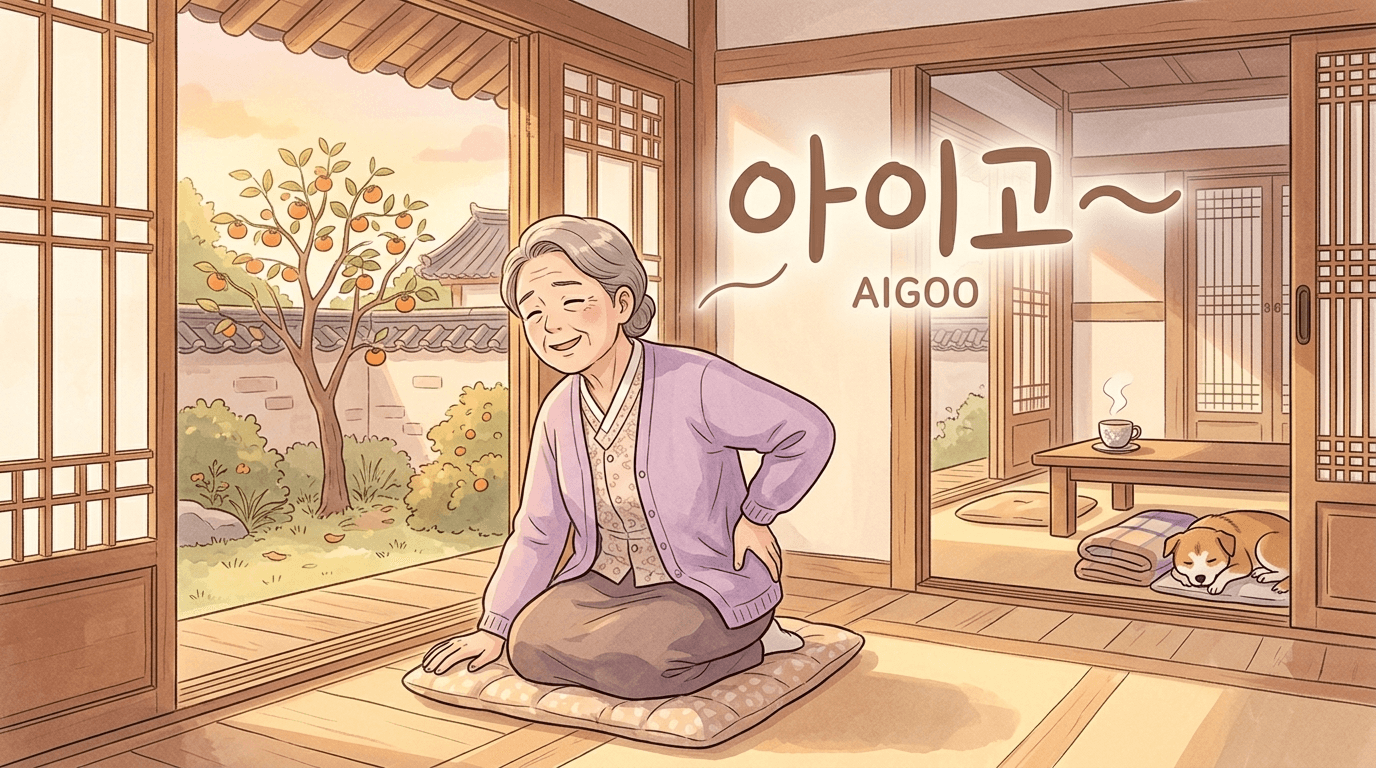
This is the version you’ll hear most often from older Koreans — especially the iconic K-drama grandmother sitting down on a wooden floor.
3. Affection and Endearment
This is the cute usage. When a grandparent sees a grandchild, an aunt sees a baby, or anyone encounters something deeply adorable, aigoo expresses melted-heart affection.
- 아이고, 우리 강아지! (Aigo, uri gangaji!) — Aww, my puppy! (often said to a child, with “puppy” as a term of endearment)
- 아이고, 예쁘다. (Aigo, yeppeuda.) — Aww, you’re so pretty.
- 아이고, 우리 손자 왔어? (Aigo, uri sonja wasseo?) — Aww, my grandson is here?
4. Surprise
Aigoo can also stand in for “Oh!” or “Whoa!” when something unexpected happens. It overlaps a little with daebak, but daebak emphasizes magnitude (“huge!”) while aigoo emphasizes the emotional shock.
- 아이고, 깜짝이야! (Aigo, kkamjjak-iya!) — Oh, you scared me!
- 아이고, 벌써 시간이 이렇게 됐어? (Aigo, beolsseo sigani ireoke dwaesseo?) — Whoa, is it already this late?
5. Grief or Sorrow
The original meaning still surfaces in moments of genuine sadness. In funerals, mourning scenes, or when receiving terrible news, a long, drawn-out “아이고~~~” expresses deep grief.
- 아이고, 어떡해... (Aigo, eotteokhae...) — Oh no, what do we do...
- 아이고, 불쌍해. (Aigo, bulssanghae.) — Oh, that’s so sad.
6. Sympathy or Concern
When someone tells you bad news or shares something difficult, aigoo is a warm verbal hug.
- 아이고, 많이 아팠겠다. (Aigo, mani apatgetda.) — Oh dear, that must have hurt a lot.
- 아이고, 고생했어요. (Aigo, gosaenghaesseoyo.) — Oh, you’ve worked so hard.
7. Affectionate Exasperation
One of the most charming uses: aigoo paired with a soft scolding tone, expressing “you again? you ridiculous, lovable person.”
- 아이고, 또 그래? (Aigo, tto geurae?) — Oh you, again?
- 아이고, 못 말려. (Aigo, mot mallyeo.) — Geez, I can’t even with you.
Aigoo in K-Dramas: Why It’s Everywhere
Aigoo is the unofficial signature of the K-drama grandmother and the K-drama auntie. If a halmeoni (grandmother) opens her mouth on screen, the odds are 70% that her first word will be aigoo. But the word isn’t limited to older characters — younger characters use it constantly too, especially in everyday moments where English would use a small sigh or a soft “ugh.”
The Halmeoni Scene
Drawing back a sliding door, sitting down on the heated floor, and exhaling a long “아이고~~” is practically a stock K-drama beat. It signals warmth, age, exhaustion, and home all at once.
The Confession Sigh
When a character is about to confess something difficult — a secret, a mistake, a feeling — a short, defeated “아이고...” often precedes it. It tells the audience the character is bracing themselves emotionally.
The “Found Out” Moment
When a character is caught doing something embarrassing or wrong, the reaction is often: 아이고, 어떡해? (Aigo, eotteokhae?) — “Oh no, what do I do?” This pairing of aigoo + eotteokhae is one of the most-repeated K-drama lines in existence.
The Comedy Aigoo
Variety shows use aigoo for comedic effect constantly. When a contestant fails a challenge or stumbles on stage, the cast erupts in a chorus of “아이고~~~” while subtitles flash dramatically across the screen.
Aigoo Across Generations
One of the interesting things about aigoo is how it sits across age groups. Older Koreans — grandparents, aunties, older parents — use it heavily and naturally. It’s a core part of their speech rhythm.
Younger Koreans use it too, but often half-jokingly, mimicking the way their parents and grandparents say it. A college student dropping “아이고~~~” onto a wooden bench after a long study session is leaning into the older-generation cadence on purpose, like a wink. The word feels comfortable, familiar, and a little nostalgic.
This generational layering is part of what makes aigoo culturally rich. Our broader guide to Korean slang from K-dramas and K-pop covers more expressions that carry these same generational textures.
Aigoo vs. Other Korean Sigh Words
아이고 (aigoo) vs. 어머 (eomeo)
어머 (eomeo) is another Korean exclamation, but it’s used more for surprise or shock — closer to “Oh my!” or “My goodness!” Eomeo is heard most often from women, especially middle-aged and older. Aigoo covers a much wider emotional range and is gender-neutral.
아이고 (aigoo) vs. 헐 (heol)
헐 (heol) is younger, sharper, and more shock-driven — closer to “OMG” or “whaaat.” Aigoo is older, warmer, and emotionally broader. A teenager hearing scandalous gossip says heol. A grandmother seeing her grandkid says aigoo.
아이고 (aigoo) vs. 아 (ah)
A simple 아 (ah) is the all-purpose Korean filler sound. Aigoo is more specific — it carries actual emotional weight, even when used casually.
When Not to Use Aigoo
Aigoo is mostly fine in casual situations, but a few notes:
- Formal business meetings. Sighing “aigoo” in front of clients or your boss can read as unprofessional or dramatic. Save it for casual moments.
- Don’t overdo it. Non-Koreans sometimes latch onto aigoo and overuse it, which can come across as performative. Use it when you genuinely feel the emotion behind it.
- Match the energy. A drawn-out funeral-style aigoo over a small inconvenience can sound theatrical. Match the length and tone of the word to the size of the moment.
Common K-Drama Lines with Aigoo
- 아이고, 어떡해! (Aigo, eotteokhae!) — Oh no, what do I do!
- 아이고, 깜짝이야. (Aigo, kkamjjak-iya.) — Geez, you scared me.
- 아이고, 우리 새끼. (Aigo, uri saekki.) — Aww, my baby. (Said by parents/grandparents)
- 아이고, 힘들어 죽겠다. (Aigo, himdeureo jukgetda.) — Ugh, I’m dying of exhaustion.
- 아이고, 됐어, 됐어. (Aigo, dwaesseo, dwaesseo.) — Geez, enough, enough.
- 아이고, 진짜? (Aigo, jinjja?) — Oh my, really?
How to Practice Aigoo Naturally
Aigoo is one of those words you almost have to feel rather than memorize. The pronunciation is easy — the tricky part is calibrating tone to emotion. A breezy aigoo for a small inconvenience, a warm aigoo for a cute baby, a heavy aigoo for sad news.
The fastest way to internalize it is to hear it in context over and over. Watching K-dramas with Korean subtitles helps you catch when characters use it. Practicing conversations with apps like Chingu — where Korean-speaking friend characters react in real time — lets you experiment with dropping aigoo into different emotional moments and see how it lands. Our conversation practice guide has more on building this kind of expressive fluency.
Frequently Asked Questions
What does aigoo mean in Korean?
아이고 (aigoo) is a Korean interjection used to express a wide range of emotions — frustration, exhaustion, surprise, affection, sympathy, or grief. It has no direct English equivalent. Depending on tone and context, it can mean “oh my,” “oof,” “ugh,” “aww,” or “oh dear.” Koreans use it constantly in daily life, especially older speakers.
Is aigoo spelled aigo, aigoo, or aigu?
All three romanizations are common. The standard Hangul spelling is 아이고, romanized as “aigo.” You’ll also see “aigoo” (closer to the spoken sound) and “aigu” (an older or dialectal variant written 아이구). A sharper variant, 아이쿠 (aiku), is used for sudden surprise or pain. All refer to essentially the same word.
Is aigoo used by young Koreans?
Yes, although it’s more associated with older speakers. Younger Koreans use it casually and sometimes half-jokingly, leaning into the older-generation cadence. It’s never out of fashion — it’s a core piece of spoken Korean across all age groups.
Can aigoo mean “ouch”?
Sort of. For a sudden injury or shock, Koreans usually use 아이쿠 (aiku) or 아야 (aya, the direct equivalent of “ouch”). But a drawn-out 아이고 can also follow stubbing your toe or bumping your head — it covers both the pain and the “ugh, really?” reaction.
Why do K-drama grandmothers say aigoo so much?
Aigoo is deeply embedded in older Korean speech patterns. It serves as a verbal release for exhaustion, surprise, and emotion, and older Koreans use it constantly throughout daily life — sitting down, getting up, seeing grandchildren, hearing news. K-drama writers lean into this because it’s a fast, authentic shorthand for the warmth and weariness of a Korean halmeoni (grandmother).
Is aigoo rude?
No, aigoo itself isn’t rude — it’s an emotional interjection, not a curse word. However, it can come across as informal or theatrical in formal settings like business meetings or with strangers in respectful contexts. In casual conversations with friends or family, it’s completely appropriate and very natural.