Chingu
Korean Words Every K-pop Fan Should Know (2026)
The essential K-pop Korean glossary. What bias, maknae, aegyo, daebak, hwaiting, comeback, and more actually mean, with Hangul, romanization, and how idols and fans really use them.
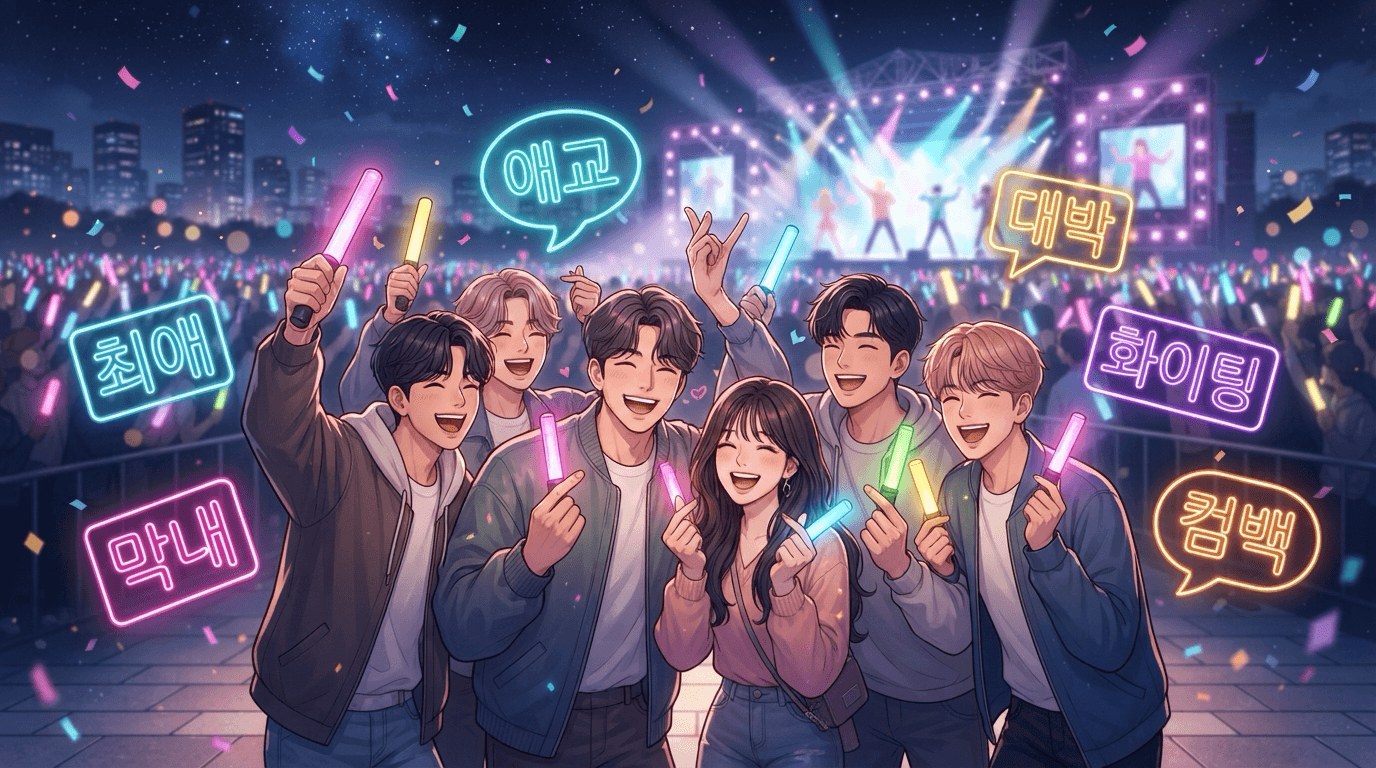
If you love K-pop, you already know more Korean than you think. Words like daebak, bias, maknae, and aegyo come up constantly in fancams, variety shows, and fan chats. Learning what they actually mean, and how to read them in Hangul, is one of the most fun ways to start learning Korean. This glossary collects the K-pop words worth knowing, grouped by how you will actually run into them.
For deeper dives on a few of these, we also have full guides to what daebak means, what oppa, hyung, unnie, and noona mean, and what borahae means.
Fandom and Bias
- 최애 (choae): your bias. Your absolute favorite member of a group. Literally “most loved.” English-speaking fans often just say “bias.”
- 차애 (chaae): your bias wrecker. Your second favorite, the one always threatening to steal the top spot.
- 입덕 (ipdeok): falling into the fandom. The moment you become a fan. There is even 입덕 영상 (ipdeok yeongsang), the “fancam that made me a fan.”
- 탈덕 (taldeok): leaving the fandom. The opposite of ipdeok.
- 덕질 (deokjil): stanning. The activity of being a dedicated fan, collecting, streaming, and following your favorites.
- 아미 (ami): ARMY, the BTS fandom, written and pronounced as 아미 in Korean. Most fandoms have their own name.
Members and Roles
- 막내 (maknae): the youngest member. Every group has one, and the maknae often plays a playful, babied role. A member who acts bold despite being youngest is a 막내 온탑 (maknae on top).
- 리더 (rideo): leader, the member who represents and guides the group.
- 비주얼 (bijueol): visual, the member considered the face of the group.
- 센터 (senteo): center, the member positioned front and center in performances.
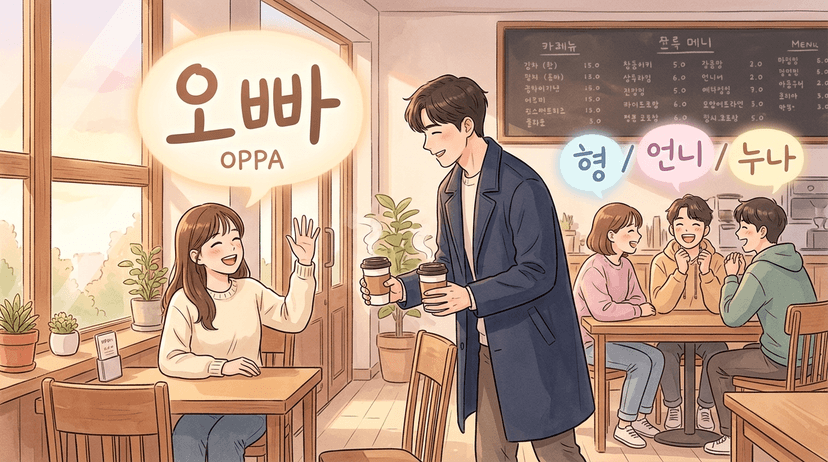
- 오빠 / 형 / 언니 / 누나 (oppa / hyeong / eonni / nuna): how fans and members address older members, depending on gender. We break these down fully in our oppa guide.
Performance and Charm
- 애교 (aegyo): cuteness on purpose. The act of being adorable through cute voices, gestures, and expressions. Idols are constantly asked to “do aegyo” on variety shows.
- 무대 (mudae): stage. A performance. A great live is called a 무대 맛집 (mudae matjip), literally a “stage restaurant,” meaning a group that always serves.
- 직캠 (jikkaem): fancam, a video focused on one member during a performance.
- 안무 (anmu): choreography. A tough dance is 안무가 빡세다 (anmuga ppakseda), “the choreo is intense.”
- 고음 (goeum): high note, the moment a vocalist hits an impressive high note.
Reactions and Slang
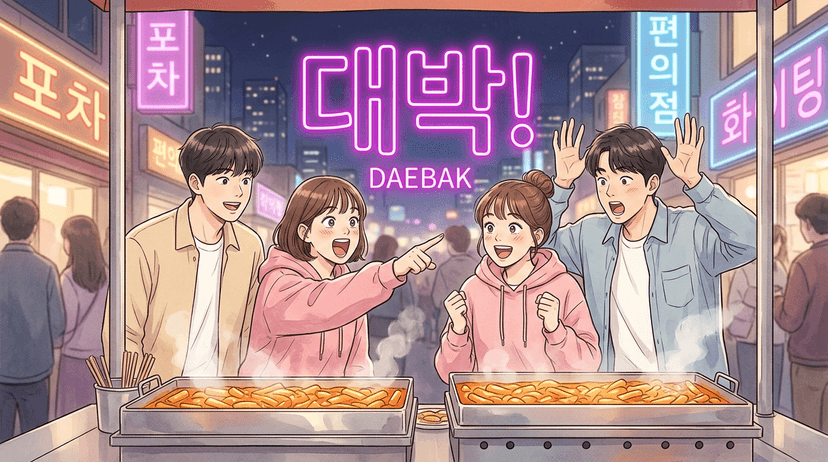
- 대박 (daebak): awesome / jackpot. The all-purpose exclamation for anything amazing or shocking. Read the full daebak guide for every use.
- 파이팅 / 화이팅 (paiting / hwaiting): you got this! A cheer of encouragement, from the English word “fighting.” Fans shout it to support idols.
- 짱 (jjang): the best. Casual slang for “awesome” or “number one.”
- 최고 (choego): the greatest. A cleaner way to say “the best,” often paired with a thumbs up.
- 심쿵 (simkung): heart attack (the good kind). That flutter when an idol does something too charming to handle.
Comebacks and the Industry
- 컴백 (keombaek): comeback, a group returning with new music. K-pop uses this for every release, not just after a long break.
- 데뷔 (debwi): debut, a group or member's official first appearance.
- 타이틀곡 (taiteulgok): title track, the main promoted song of an album.
- 음방 (eumbang): music show, short for 음악 방송, the weekly TV programs where groups perform and can win.
- 올킬 (olkil): all-kill, when a song tops every major music chart at once.
Fans, Streaming, and Merch
- 총공 (chonggong): organized effort, fans coordinating mass streaming or voting to boost their group.
- 굿즈 (gutjeu): goods / merch, official or fan-made merchandise.
- 포카 (poka): photocard, the collectible cards fans trade, short for 포토카드.
- 응원법 (eungwonbeop): fan chant, the memorized cheer fans call out during a song.
- 사생 (sasaeng): a sasaeng fan, an obsessive fan who invades idols' privacy. This one is negative, so use it carefully.
Love and Loyalty
- 사랑해 (saranghae): I love you (casual). The phrase every fan learns first.
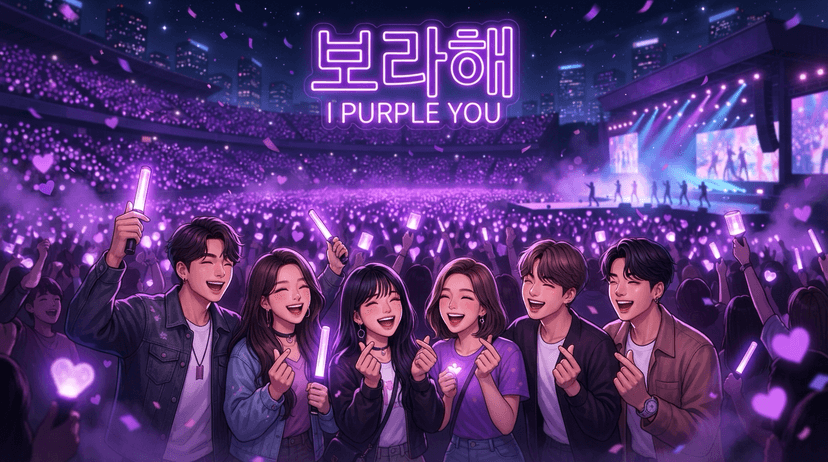
- 보라해 (borahae): I purple you, BTS and ARMY's signature phrase. Full story in our borahae guide.
- 영원히 (yeongwonhi): forever, often paired with 함께 (hamkke, together) in fan messages.
From Fan Words to Real Korean
Here is the good news: knowing these words means you have already started learning Korean. The jump from recognizing 최애 or 대박 to actually speaking is smaller than it looks, because the motivation is already there. The fastest way to close that gap is to hear these words in real sentences and say them out loud. That is what Chingu is designed for. You take a short lesson, then call a friendly Korean friend to practice, with subtitles when you need them. Start with the words you love, and before long you will be following interviews and lyrics without the subtitles at all.